Adhik Maas Conflicts When Regions Disagree on Time
By Pt. Sanjeev Sharma
The Complexity of Lunar-Solar Synchronization and Differences in Regional Calculation Methods
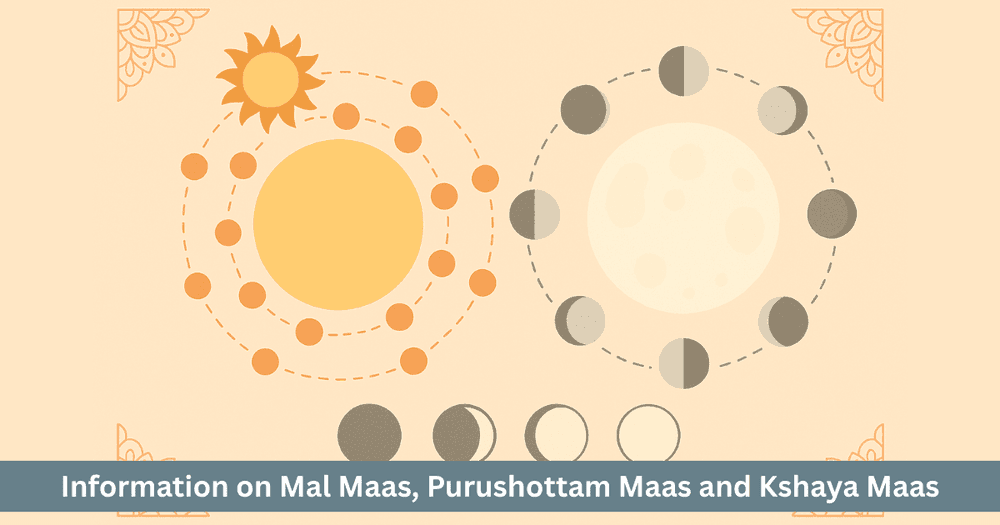
Table of Contents
Adhik Maas, literally meaning extra month, represents one of the most sophisticated and complex mechanisms in Vedic timekeeping yet also one of the most contentious, causing significant disagreements between regions, Panchang authorities and astronomical calculation methodologies. These conflicts arise not from computational errors but from the inherent complexity of synchronizing lunar and solar cycles and the various legitimate interpretations of ancient astronomical texts. It is not merely a calendar adjustment but a complex phenomenon demonstrating India's cultural diversity and the depth of astronomical knowledge.
The Fundamental Problem and the 11-Day Gap
Astronomical Imbalance
The core reason Adhik Maas exists stems from a fundamental mismatch between Earth's celestial cycles. The lunar year contains 12 synodic lunar months totaling 354 days, 8 hours, 34 minutes and 28 seconds. On the other hand, the solar year meaning Earth's revolution is 365 days, 6 hours, 9 minutes and 54 seconds. Thus, the annual shortfall is 10 days, 21 hours and 35 minutes. Over three solar years, this accumulated difference reaches approximately 33 days, equivalent to one complete lunar month.
Metonic Cycle Foundation
Ancient Indian mathematicians discovered that 19 solar years approximately equal 235 lunar months with only 0.2 days discrepancy. This realization led to the determination that seven intercalary months meaning Adhik Maas occur in a 19-year cycle, typically in the 3rd, 5th, 8th, 11th, 14th, 16th and 19th years.
Technical Definition and the No-Sankranti Rule
The Defining Criterion
Adhik Maas is defined as the lunar month in which no Sankranti meaning solar transition occurs. This is the most scientifically precise definition but also the source of considerable conflict. During any given month, the Sun transits from one zodiac sign meaning Rashi to another, marking a Sankranti. A normal month contains exactly one Sankranti. however occasionally two Sankrantis fall within a single lunar month due to the varying orbital velocities of the Sun and Moon.
When this occurs, the lunar month containing two Sankrantis becomes a doubled month and the previous month containing zero Sankrantis is designated as Adhik Maas meaning the extra month. Alternatively, in some calculations, if a lunar month has no Sankranti, it becomes Adhik Maas.
Example Scenario
In some years, the Sankranti might occur on June 5 and the next Sankranti on July 3. If a complete lunar month spans June 10 to July 8, it would contain only the July 3 Sankranti. Meanwhile, if another lunar month earlier spans May 10 to June 8, it contains zero Sankrantis making it Adhik Maas.
Sources of Conflict
Calculation Method Variations
Drik Ganita meaning Modern Computational Method: Uses contemporary astronomical algorithms based on NASA ephemeris data and precise orbital mechanics. This method calculates Sankranti to the exact moment using modern planetary position tables.
Vakya Panchang meaning Traditional Method: Employs ancient formulas from the Surya Siddhanta texts, using mathematical shortcuts developed centuries ago. While tested over time, these formulas can diverge from actual astronomical values by up to 12 hours.
Conflict Result: Different calculation methods often identify different months as Adhik Maas or determine different years as having Adhik Maas.
Sunrise Definition Variations
Different Panchang authorities use different sunrise thresholds for determining Sankranti occurrence.
- Upper Limb: When the top edge of the Sun becomes visible meaning slightly earlier.
- Center Limb: When the Sun's center reaches the horizon meaning standard definition.
- Horizon Standard: Various interpretations based on latitude and elevation.
A difference of 2 to 8 minutes in sunrise definition can shift whether a Sankranti falls in the current month or the next month, thus determining which month lacks a Sankranti.
Regional Panchang Variations
Different regional calendar authorities publish different Adhik Maas determinations based on their specific calculation traditions and geographical considerations.
- North Indian Panchang: May determine Adhik Maas occurring in month X.
- South Indian Panchang: Might determine Adhik Maas occurring in month Y during the same year.
- Regional Temple Authorities: Often maintain their own historical calculation methods.
This creates situations where two authentic Panchang sources publish different Adhik Maas months for the same year.
Historical Examples of Adhik Maas Conflicts
2020 Adhik Maas Controversy
Different Panchang authorities disagreed on the exact dates. North Indian Panchang stated September 18, 2020 to October 16, 2020 while some South Indian authorities stated different dates citing Amanta versus Purnimanta calculations. For dispute resolution, multiple Panchang publications and temple authorities published conflicting calendars.
2018 Adhik Jyeshtha
When Adhik Maas occurred as Adhik Jyeshtha meaning extra Jyeshtha month, different astrologers recommended different observance protocols.
Precession-Related Drift
Over centuries, the dates of Makar Sankranti meaning January 14 and Mesha Sankranti meaning April 14 have shifted by approximately 23 days due to axial precession. This ongoing drift creates ongoing recalculation needs and occasional disputes about which month truly lacks a Sankranti.
Which Months Can or Cannot Be Adhik Maas
Restricted Months
Complex traditional rules severely limit which months can become Adhik Maas, based on historical Panchang conventions.
| Months That CANNOT Be Adhik Maas | Months That CAN Be Adhik Maas | Rare Occurrences |
|---|---|---|
| Margashirsha | Chaitra | Kartik meaning once every 250 years |
| Pausha | Vaisakha | |
| Magha | Jyeshtha | |
| Ashadha | ||
| Shravan | ||
| Bhadrapada | ||
| Ashwin |
Reason for Restrictions
These restrictions preserve the integrity of festival calendars. The months of Margashirsha, Pausha and Magha contain crucial solar festivals such as Makara Sankranti and winter solstice markers that must occur at fixed positions in the year for agricultural and celestial significance.
Occurrence Frequency
Adhik Maas falls within the same month only once every 19 years on average. For example, when Adhik Maas occurs as Adhik Jyeshtha, the next Adhik Jyeshtha will not occur for approximately 19 years.
Naming Controversies: Mal Maas versus Purushottam Maas
Two Contradictory Names
The same month has acquired two diametrically opposite names, creating theological and practical confusion.
Mal Maas meaning Dirty or Inauspicious Month:
Represents the month lacking Tejah meaning brightness or sanctifying qualities of the Sun's Sankranti. Considered inauspicious for initiating new ventures, particularly marriages, sacred thread ceremonies, housewarming and business inaugurations. Astrologers advise postponing major life events to subsequent months.
Purushottam Maas meaning Month of the Supreme Lord Vishnu:
Mythological narrative states when none of the 12 deities wanted to oversee this unpredictable month, Lord Vishnu accepted it for himself. Considered supremely auspicious for spiritual activities such as worship, chanting, charity, fasting, pilgrimage and scripture study. Devotees believe acts performed earn 10 times spiritual merit than normal months.
The Conflict
This duality creates regional and sectarian disagreements. Conservative practitioners avoid all worldly activities during Mal Maas. Devotional practitioners emphasize Purushottam Maas for intensive spiritual work. Vaishnava tradition heavily emphasizes Purushottam Maas's Vishnu-connected auspiciousness. Non-Vaishnava traditions may treat it primarily as inauspicious Mal Maas.
Practical Conflicts in Festival Scheduling
Festival Repetition Problem
When Adhik Maas occurs, festivals associated with that month name technically occur twice. For example, if Adhik Jyeshtha meaning extra Jyeshtha is determined for a year, Ganga Dussehra celebrated in Jyeshtha Shukla Dasami could theoretically occur in both Shudha Jyeshtha meaning pure or main Jyeshtha and Adhik Jyeshtha meaning extra Jyeshtha.
Resolution Protocols
- Primary Festival Rule: The festival is celebrated in Shudha Maas meaning the pure original month.
- Adhik Maas Observance: Corresponding deities can be worshipped during Adhik Maas but with reduced formal significance.
- Regional Variation: Some regions celebrate both occurrences, others only the Shudha occurrence.
Kshaya Maas The Opposite Phenomenon
When Months Disappear
The inverse of Adhik Maas is Kshaya Maas, when a month is entirely deleted from the calendar. Kshaya Maas occurs when two consecutive Sankrantis fall within the same lunar month, leaving no lunar month between them. The month lacking a Sankranti on either boundary is considered dropped.
Rarity
Kshaya Maas is extraordinarily rare, occurring roughly once every 140 to 190 years.
Historical Example
In 1 BCE, the month of Pausha was dropped because no new moon occurred between Makara Sankranti and Kumbha Sankranti.
Authority Conflicts and Resolution
Multiple Panchang Authorities
No single Panchang authority has universal acceptance across India.
- Government of India: Publishes National Panchang or Rashtriya Panchang based on Drik Ganita.
- Regional Temple Authorities: Maintain traditional calculation methods specific to their regions.
- Private Panchang Publishers: Produce dozens of distinct Panchangs with varying calculations.
- Vaishnava Authorities: Emphasize Purushottam Maas significance.
- Regional Astrology Guilds: Preserve regional calculation traditions.
Conflict Management
Rather than enforcing uniformity, Indian tradition honors regional variations. Individuals follow their regional Panchang authority. Families maintain generational Panchang traditions. Temple authorities determine festival dates for their constituencies. No single authority can mandate uniform Adhik Maas dates across India.
Modern Technology and Ongoing Disputes
Digital Panchangs
Modern apps and online calculators sometimes publish conflicting Adhik Maas determinations. Different algorithms produce different results. User confusion when multiple apps show different months. Continued reliance on traditional authorities despite digital tools.
Scientific Committees
Occasional initiatives by astronomical organizations to standardize Adhik Maas calculation methodology have had limited adoption due to resistance to abandoning traditional methods, regional autonomy preferences and sectarian differences in observance philosophies.
Philosophical Perspectives on Conflicts
Rather Than Errors
Indian astronomical tradition views these conflicts not as failures but as reflections of reality's complexity. The Panchang captures genuine astronomical uncertainty. Multiple valid perspectives reflect the sophistication of calculations. Conflicts invite deeper spiritual and philosophical contemplation. No wrong answer, only different valid interpretations.
Scholar's Note
The inability to reduce Adhik Maas determination to a single formula reflects the profound sophistication of Vedic timekeeping. It operates at the intersection of precise mathematics and cosmic complexity, making it appropriately multifaceted rather than monolithic.
Practical Impact on Practitioners
Planning Challenges
Individuals planning important life events face uncertainty. Wedding planners must consult multiple Panchangs. Astrologers often recommend waiting for Panchang agreement. In contested years, families follow their own traditional authorities. Religious institutions publish their own Adhik Maas determinations.
Workaround Traditions
The Hindu calendar maintains flexibility mechanisms. Festivals can be observed on either day if dated in Adhik Maas years. Multiple celebration dates allow broader community participation. Flexibility honors both worldly meaning inauspicious and spiritual meaning auspicious interpretations.
Amanta versus Purnimanta Systems
Primary Driver of Disagreement
The primary driver of disagreement is the two different systems for reckoning lunar months.
Amanta System:
Followed in Southern and Western India such as Maharashtra, Gujarat andhra Pradesh. This system defines a month as the period from one new moon meaning Amavasya to the next. The month begins the day after the new moon.
Purnimanta System:
Prevalent in Northern India, this system marks the month from one full moon meaning Purnima to the next. The month begins the day after the full moon.
| Feature | Amanta System | Purnimanta System |
|---|---|---|
| Month Start | Day after New Moon meaning Amavasya | Day after Full Moon meaning Purnima |
| Month End | New Moon meaning Amavasya | Full Moon meaning Purnima |
| Month Structure | Shukla Paksha followed by Krishna Paksha | Krishna Paksha followed by Shukla Paksha |
| Adhik Maas Label | Named based on the month that begins after the Amavasya | Named based on the month that begins after the Purnima |
This 15-day offset in the start and end of a month means that the 30-day period without a Sankranti can fall within differently named months in each system. For example, if a Sankranti-less period occurs, an Amanta calendar might label it Adhik Shravan, while a Purnimanta calendar might call it Adhik Bhadrapad, even though both are referring to the same astronomical event. This is a conflict of naming, not of celestial timing.
Frequently Asked Questions
Why is Adhik Maas necessary?
Adhik Maas is necessary to balance the difference between the lunar year meaning 354 days and the solar year meaning 365 days to ensure festivals remain aligned with their traditional seasons.
Why do different regions disagree on Adhik Maas?
Disagreement arises from differences in Amanta versus Purnimanta systems, Drik versus Vakya calculation methods, sunrise definitions and regional Panchang traditions.
What is the difference between Mal Maas and Purushottam Maas?
These are two names for the same month. Mal Maas considers it inauspicious for worldly activities while Purushottam Maas considers it supremely auspicious for spiritual activities.
What is Kshaya Maas?
Kshaya Maas is the opposite of Adhik Maas, when a month is entirely deleted from the calendar because two Sankrantis fall within the same lunar month. It occurs once every 140 to 190 years.
How are festivals celebrated during Adhik Maas?
Most festivals are celebrated in Shudha Maas meaning the original month, not in Adhik Maas. however corresponding deities can also be worshipped during Adhik Maas but with less formal significance.
Get your accurate Kundali
Generate KundaliDid you like it?
Author

Pt. Sanjeev Sharma (63)
Experience: 20
Consults About: Family Planning, Career
Clients In: Punjab, Haryana, Delhi
Share this article with friends and family
WELCOME TO
ZODIAQ
Right Decisions at the right time with ZODIAQ
500+
USERS
100K+
TRUSTED ASTROLOGERS
20K+
DOWNLOADS
