How Regional Panchangs Shaped Indian Agriculture
By Pt. Nilesh Sharma
Six Seasons, Nakshatra-Based Agriculture and the Traditional Sustainable Farming System
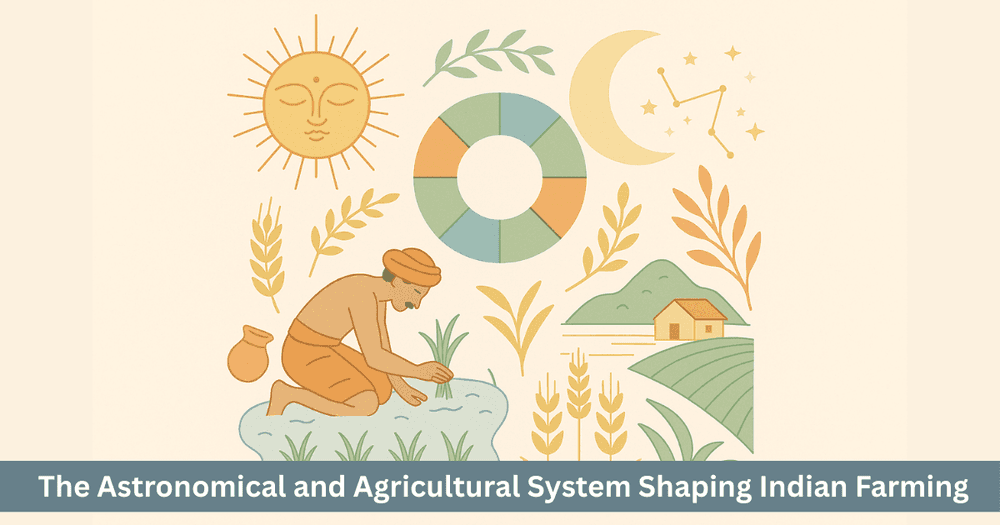
Table of Contents
The Panchang system represents one of the most sophisticated agricultural frameworks ever developed, integrating astronomical observations with farming practices to create a sustainable, cyclical approach to agriculture that has sustained Indian civilization for millennia. This ancient Krishi-Panchang (agricultural Panchang) provided farmers with precise guidance on planting, irrigation, harvesting and pest management, harmonizing human labor with celestial rhythms and natural seasons.
The Foundation: Six Seasons and Crop Cycles
Vedic Classification of Seasons
The Panchang divides the agricultural year into six distinct seasons (Ritus), each lasting approximately two months and governed by specific solar transitions and agricultural imperatives.
| Season (Ritu) | Gregorian Dates | Months | Characteristics | Agricultural Significance |
|---|---|---|---|---|
| Vasanta (Spring) | March – May | Chaitra, Vaisakha | Pleasant weather, rebirth, blooming flowers | Preparation of fields, tilling, preparing seeds for sowing |
| Grishma (Summer) | May – July | Jyeshtha, Ashadha | Intense heat, dry conditions | Drought-resistant crops like millets and pulses; water conservation |
| Varsha (Monsoon) | July – September | Shravana, Bhadrapada | Heavy rainfall, relief from heat | Kharif crop sowing (rice, paddy); flood prevention; erosion management |
| Sharad (Autumn) | September – November | Ashwin, Kartik | Clear skies, post-monsoon clarity | Primary harvest season; crop maturity; major agricultural festivals |
| Hemanta (Pre-winter) | November – January | Margashirsha, Pausha | Cool breezes, falling temperatures | Rabi crop sowing (wheat, mustard, oilseeds); root crop cultivation |
| Shishira (Winter) | January – March | Magha, Phalguna | Coldest temperatures, frosty mornings | Harvest and storage; root vegetable extraction; field rest and preparation |
Each seasonal transition is marked by Sankranti (solar transition), where the Sun moves from one zodiac sign to another, signaling specific agricultural imperatives and determining the planting and harvesting calendars.
Sankranti Festivals Agricultural Milestones
Makar Sankranti The Harvest Festival
The most significant agricultural celebration, Makar Sankranti, marks the Sun's transition into Capricorn around January 14, signaling the end of winter and beginning of longer, warmer days. This festival coincides directly with the primary harvest season when major winter crops ripen and mature.
Agricultural Significance of Makar Sankranti:
Crop Maturity: Winter crops including rice, sugarcane, turmeric, wheat, mustard and pulses reach full maturity and are ready for harvest.
Onset of Warmth: The transition indicates increasing temperatures and longer daylight, crucial for ripening processes.
Farmer's Celebration: Represents the culmination of months of labor and the abundance of harvest, celebrated across India with regional variations:
- Pongal in Tamil Nadu
- Bihu in Assam
- Lohri in Punjab
- Magh Bihu in northern states
- Makar Lights in Kerala
Cattle Veneration: Farmers honor cattle (oxen, cows) with baths, parades and special decorations, acknowledging their critical role in agriculture ploughing fields, transportation and fertilizer production.
Traditional Foods: Farmers prepare sweets made from jaggery and sesame seeds, symbolizing sweetness, togetherness and gratitude for abundance.
Three Crop Seasons and Panchang Guidance
The Panchang system explicitly recognizes and governs three major crop seasons tied to monsoon patterns and solar movements.
1. Kharif Season (June October)
Defining Feature: Sown with monsoon rains beginning in Varsha Ritu (July August)
Timing: Farmers begin ploughing in May June when soil moisture increases, then wait for first monsoon rains in June
Panchang Role: Guides initial land preparation dates, identifies auspicious Nakshatras for sowing
Crops: Rice (primary), paddy, cotton, maize, millets, sugarcane, groundnut, soybean
Harvest: September October during Sharad Ritu (autumn)
2. Rabi Season (October March)
Defining Feature: Sown after monsoon withdrawal in Hemanta Ritu (October November)
Timing: Begins after moisture from retreating monsoon supports germination without excess water
Panchang Role: Specifies auspicious dates for sowing different crops, determines watering schedules
Crops: Wheat, barley, mustard, lentils, chickpea, peas, oilseeds, rye
Harvest: March May during Vasanta and early Grishma Ritus
3. Summer/Zaid Season (March May)
Definition: Short-duration crops in spaces between major seasons
Panchang Role: Guides scheduling of vegetables and short-cycle crops
Crops: Vegetables (cucumbers, melons, squash), herbs, short-cycle pulses
Significance: Bridges seasons, maintains field productivity year-round
Nakshatra-Based Farming Astronomical Guidance for Crop Activities
The 27 Nakshatras (lunar constellations/mansions) form the sophisticated celestial framework guiding specific agricultural operations. Each Nakshatra possesses unique elemental properties and energy patterns that correlate with optimal plant responses.
The 27 Nakshatras and Their Agricultural Associations
| Nakshatra | Ideal Crop Activity | Elemental Property | Traditional Belief & Scientific Basis |
|---|---|---|---|
| Rohini | Sowing cereals & pulses | Earth | Enhances fertility and seed vitality; promotes robust growth and higher yields |
| Pushya | Transplanting vegetables | Water | Encourages good root establishment; water element supports nutrient uptake |
| Mrigashira | Ploughing, land preparation | Air | Improves microbial activity and soil aeration; loosens compacted earth |
| Bharani | AVOID for sowing | Fire | Associated with drying energy that may reduce germination rates and seedling vigor |
| Revati | Harvesting & storage | Ether | Improves shelf-life and post-harvest produce quality; associated with preservation |
| Moola | Root vegetable planting | Earth | Encourages deep root development; strong foundation establishment |
| Swati | Legumes & fruits | Air | Supports fruit-bearing capacity; enhances above-ground growth |
Practical Nakshatra Farming Implementation
Crop-Specific Planting: Different crops have "favorite" Nakshatras that optimize their particular growth patterns. For example, farmers plant root vegetables (carrots, beetroot, turmeric, onions) during Moola Nakshatra because the Nakshatra's Earth element promotes strong root development.
Lunar Phase Synchronization: Farmers align crop activities with Moon phases within Nakshatras:
- Waxing Moon (Shukla Paksha): Favorable for leafy vegetables, herbs and above-ground crops (lettuce, spinach, coriander)
- Waning Moon (Krishna Paksha): Optimal for root crops and tubers (carrot, beetroot, turmeric) that benefit from root-promoting energy
Pest Control with Lunar Cycles: Traditional farmers observed that pest outbreaks follow lunar rhythms. By synchronizing natural pest control methods with moon phases, farmers reduce chemical pesticide dependency and work cooperatively with natural pest populations.
Tithi-Based Farming Practices
Tithi Characteristics
Each of the 30 tithis (lunar days) has distinct properties affecting plant growth. The Panchang Krishi guide specifies which tithis favor certain agricultural activities:
Shukla Paksha (Waxing Moon) 15 Tithis:
Auspicious for: Sowing above-ground crops, watering, applying fertilizers, pest prevention
Energy Pattern: Growth-promoting, accumulative, energizing
Recommended Crops: Leafy vegetables, fruit-bearing plants, pulses
Krishna Paksha (Waning Moon) 15 Tithis:
Auspicious for: Harvesting, pruning, weeding, pest control
Energy Pattern: Destructive (to pests/weeds), preservative, drying
Recommended Crops: Root crops, storage crops, crops requiring longevity
Vara (Weekday) and Farm Operations
Each day of the week is governed by a celestial body with specific agricultural resonances:
- Monday (Moon): Associated with water; ideal for irrigation and watering activities
- Tuesday (Mars): Associated with energy; good for soil preparation and field work
- Wednesday (Mercury): Associated with growth; favorable for transplanting
- Thursday (Jupiter): Associated with expansion; good for sowing and expansion activities
- Friday (Venus): Associated with prosperity; favorable for starting new agricultural ventures
- Saturday (Saturn): Associated with discipline; suitable for maintenance and storage work
- Sunday (Sun): Associated with vitality; favorable for general field activities
The Five-Element Framework
The Panchang integrates the five Pancha Bhootas (cosmic elements) into agricultural guidance:
1. Prithvi (Earth)
Associated with Nakshatras: Rohini, Moola, Uttara Phalguni
Agricultural Function: Fertility, seed vitality, root development, soil stability
Practice: Engage in earth-related activities like ploughing, land preparation, root crop planting
2. Jala (Water)
Associated with Nakshatras: Pushya, Anuradha, Shatabhishak
Agricultural Function: Moisture retention, nutrient transport, growth promotion
Practice: Schedule irrigation and transplanting during water-element Nakshatras
3. Vayu (Air)
Associated with Nakshatras: Mrigashira, Swati, Dhanishtha
Agricultural Function: Aeration, microbial activity, pest prevention
Practice: Perform ploughing and weeding to improve soil aeration
4. Agni (Fire)
Associated with Nakshatras: Bharani, Purva Phalguni, Purva Ashadha
Agricultural Function: Transformation, drying, ripening
Practice: Avoid sowing (drying energy reduces germination); suitable for harvesting and storage
5. Akasha (Ether)
Associated with Nakshatras: Revati, Ashwini, Uttara Ashadha
Agricultural Function: Preservation, post-harvest quality, shelf-life
Practice: Schedule harvesting and storage operations for enhanced longevity
Scientific Validation of Panchang-Based Farming
Modern Research Findings
Lunar Gravity and Soil Moisture: Scientific studies confirm that the Moon's gravitational pull affects more than ocean tides it also influences water tables and capillary movement of soil moisture, validating the ancient observation that lunar phases correlate with plant water availability.
Moon Phases and Plant Growth: Modern research supports the traditional practice:
- Waxing Moon: Favors above-ground plant growth due to increased internal water movement (sap flow)
- Waning Moon: Promotes root development as internal moisture concentrates in root systems
Cosmic Radiation: Emerging research explores how variations in cosmic radiation partially modulated by the Moon's position may affect seed germination and cellular activity, providing scientific foundation for Nakshatra-based timing.
Practical Field Results
Tamil Nadu: Agricultural families following Nakshatra-based sowing for over a century report consistent harvests even in erratic climate years, demonstrating resilience offered by working with nature's rhythms.
Bihar: Contemporary farmers in Bihar following the agricultural Panchang report significantly improved crop yields and financial returns, validating the system's continued relevance.
Benefits of Panchang-Guided Agriculture
1. Enhanced Crop Yield and Quality
Farmers following Nakshatra-based practices report greater germination rates, stronger plant structure and better-tasting produce. Field trials show 15-20% yield improvements compared to conventional scheduling. Improved nutritional content and flavor due to alignment with optimal cosmic conditions.
2. Reduced Chemical Dependency
Working in harmony with natural cycles improves soil vitality and pest resistance. Dramatically reduces reliance on synthetic fertilizers, pesticides and herbicides. Lower input costs and reduced environmental pollution. Better long-term soil sustainability.
3. Biodiversity Enhancement
Nakshatra-based farming promotes microbial diversity in soil ecosystems. Supports beneficial insects, birds and pollinators through natural pest control. Creates habitat for earthworms and beneficial microorganisms that enhance soil structure. Reduces monoculture vulnerability to pest outbreaks.
4. Climate Resilience
Cyclical farming aligned with seasonal variations adapts better to climate unpredictability. Crop diversification reduces single-crop failure risks. Traditional timing has sustained agriculture through historical climate variations.
5. Irrigation Efficiency
Water-related activities scheduled during water-element Nakshatras optimize moisture retention. Reduces water wastage through better soil preparation timing. Aligns irrigation with natural precipitation patterns.
Krishi-Panchang in Regional Agricultural Contexts
Tamil Panchang
Specifically designed as Krishi Panchang (agricultural Panchang) for Tamil farmers. The Tamil agricultural calendar provides detailed seasonal guidance and Nakshatra recommendations specific to southern Indian climate patterns, crop varieties and agricultural practices developed over centuries.
Regional Agricultural Calendars
Each major agricultural region maintains region-specific Panchang guidance:
- North India: Emphasizes winter crop guidance for wheat, mustard, pulses
- South India: Focuses on rice cultivation and tropical crop timing
- Monsoon Regions: Provides detailed Monsoon Ritu guidance for water management
Panchang Components Guiding Agricultural Decisions
Daily Panchang updates provide farmers with real-time guidance for specific activities:
- Tithi Information: Which tithi is present; recommendations for above-ground vs. root crops
- Nakshatra Data: Current Nakshatra position; suitability for specific crop operations
- Vara (Weekday): Day-specific activities (Monday = water-related; Tuesday = soil preparation)
- Yoga/Karana: Auspicious timings for starting new agricultural ventures
- Sunrise/Sunset Data: Precise timing for irrigation and water management
Traditional Wisdom in Agricultural Texts
Tree Science: The ancient treatise on plant science provides detailed guidance on Nakshatra-based farming practices, crop selection based on Nakshatras, soil preparation timing and pest management strategies.
Agriculture-Parashara: Authored by the sage Parashara, this foundational text provides rainfall prediction techniques and agricultural practices for different seasons, crops and geographical regions.
Rigveda References: The Rigveda presents detailed descriptions from ploughing to reaping, including irrigation methods, all conducted with auspicious timing to invoke blessings of universal deities.
Contemporary Integration with Modern Technology
Digital Panchang Applications
Modern apps integrate moon-phase guidance with:
- Real-time moisture monitoring using soil sensor devices
- Satellite weather data for rainfall predictions
- GPS-based field mapping for precision agriculture
- Market price information for crop selection decisions
This convergence of ancient Vedic timing with modern technology creates digital agricultural-Panchang systems that guide 21st-century farmers in optimizing planting, irrigation and harvesting decisions.
Challenges and Future Directions
Scalability Issues
While effective for small and medium-sized farms, implementing Nakshatra calendars across industrial-scale agriculture remains challenging due to mechanized farming requirements.
Scientific Recognition
The lack of large-scale, long-term peer-reviewed field trials has made mainstream agricultural scientists hesitant to formally adopt Nakshatra practices, though this is changing as biodynamic agriculture gains global certification recognition.
Climate Adaptation
As climate patterns become increasingly erratic, Panchang-guided farming's historical resilience offers valuable models for developing climate-adaptive agricultural strategies.
Frequently Asked Questions
Question 1: How does Panchang-based agriculture differ from modern scientific farming?
Panchang-based agriculture aligns farming operations with lunar cycles, Nakshatras and seasonal rhythms, while modern scientific farming focuses on soil chemistry, weather forecasting and genetically modified crops. Integrating both can provide optimal results.
Question 2: Is Nakshatra-based planting scientifically proven?
While large-scale controlled trials are limited, emerging research validates the effects of lunar gravity on soil moisture and Moon phases on plant growth. Thousands of years of empirical evidence and successful modern biodynamic farms support traditional knowledge.
Question 3: Can small farmers easily adopt Panchang-based agriculture?
Yes, small farmers benefit most. Consulting local Panchangs, observing moon phases and sowing during auspicious Nakshatras require minimal additional investment. Mobile apps now simplify access to daily Panchang guidance.
Question 4: What are the economic benefits of Panchang-guided agriculture?
Farmers report higher yields (15-20% improvement), lower input costs (reduced chemical dependency), better product quality (premium pricing) and long-term soil health (future productivity).
Question 5: How can I obtain an agricultural Panchang for my region?
Consult local scholars, agricultural department offices or download mobile apps providing region-specific Panchang guidance. Many regional language Panchangs include agriculture-specific sections.
Get your accurate Kundali
Generate KundaliDid you like it?
Author

Pt. Nilesh Sharma (63)
Experience: 20
Consults About: Family Planning, Career
Clients In: Punjab, Haryana, Delhi
Share this article with friends and family
WELCOME TO
ZODIAQ
Right Decisions at the right time with ZODIAQ
500+
USERS
100K+
TRUSTED ASTROLOGERS
20K+
DOWNLOADS
