Solar vs Lunar Panchang: Which One Precise
By Pt. Amitabh Sharma
Metonic Cycle Adhik Masa and Lunisolar Integration Deep Examination
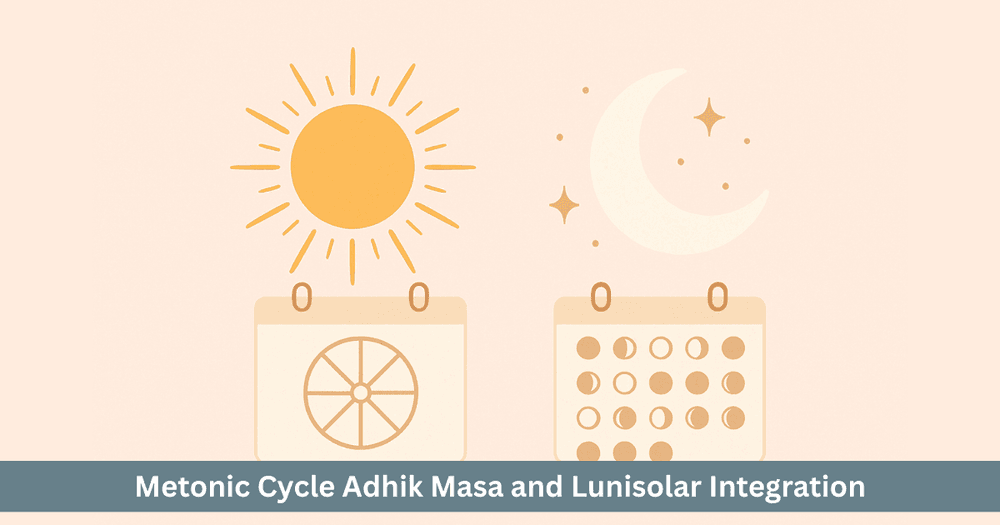
Table of Contents
The question of precision in calendrical systems requires understanding what precision means in the context of Vedic timekeeping. Whether it refers to astronomical accuracy, seasonal alignment, ease of calculation or practical functionality, both solar and lunar Panchangs embody sophisticated astronomical knowledge developed over millennia, each optimized for different purposes within the Vedic framework.
Fundamental Astronomical Realities
Solar Year Duration
A tropical solar year, the Earth's complete revolution around the Sun, equals approximately 365.2422 days (365 days, 5 hours, 48 minutes, 46 seconds). The sidereal solar year used in Hindu astronomy is slightly longer at about 365.2564 days. Modern precision has established the tropical year at 365.24217 days, requiring only one day adjustment every 3,236 years.
Lunar Month Duration
A synodic lunar month, the complete cycle of Moon phases from new moon to new moon, equals approximately 29.53059 days (29 days, 12 hours, 44 minutes, 3 seconds). This value has remained remarkably stable, with ancient Vedic calculations showing accuracy within minutes of modern measurements.
The Eleven-Day Problem
Twelve lunar months total approximately 354.36 days (12 × 29.53 = 354.36), creating a shortfall of about 10.875 days (nearly 11 days) compared to the solar year. Conversely, thirteen lunar months equal 383.90 days, about 18.6 days too many. This fundamental mismatch creates the central challenge in maintaining lunisolar calendars.
Solar Panchang Systems: Tamil and Malayalam Calendars
Pure Solar Structure
Tamil and Malayalam calendars represent the most astronomically straightforward approach to timekeeping in Indian tradition. These sidereal solar calendars base months exclusively on the Sun's transit through the twelve zodiac signs (Rashis), completely eliminating lunar phase considerations for month calculation.
Astronomical Precision of Solar Systems
The solar month system offers several precision advantages:
Fixed Seasonal Alignment: Solar months maintain perfect synchronization with seasons since they directly track the Sun's position. Mesha Sankranti (Sun entering Aries) consistently marks the spring equinox region, ensuring festivals and agricultural activities remain seasonally anchored.
No Intercalation Required: Since solar months already equal a solar year (365-366 days), there is no need for Adhik Masa (extra months) or complex intercalation rules. This eliminates the confusion and computational complexity associated with determining when to insert extra months.
Predictable Month Lengths: Solar months have consistent, predictable durations based on the Sun's angular velocity through zodiac signs. While month lengths vary from 29-32 days due to Earth's elliptical orbit, these variations follow deterministic astronomical patterns.
Direct Correspondence with Zodiac: Each month corresponds exactly to one zodiac sign, facilitating astrological calculations and creating seamless integration between calendar and horoscopy.
| Feature | Description | Advantage |
|---|---|---|
| Year Length | 365 to 366 days | Covers complete solar year |
| Adhik Masa | Not required | No computational complexity |
| Seasonal Drift | Never occurs | Perfect seasonal alignment |
| Calendar Alignment | Optimal | All sun-centered festivals accurate |
Limitations of Solar Panchang
The primary limitation of pure solar calendars is that they do not track lunar phases, which are crucial for many Hindu religious observances tied to tithis (lunar days). Tamil and Malayalam Panchangs compensate by incorporating lunar elements (Tithi, Nakshatra) as parallel information without using them for month structure.
Pure Lunar Panchang Systems
Lunar Calendar Structure
Pure lunar calendars, like the Islamic Hijri calendar, consist of 12 lunar months totaling 354 days, making the year about 11 days shorter than the solar year. This causes the calendar to drift through seasons. Over 33 years, a pure lunar calendar cycles through all seasons.
Accuracy for Lunar Phenomena
Pure lunar calendars excel at tracking Moon phases with remarkable precision:
- The Islamic calendar maintains accuracy to one day in about 2,500 solar years or 2,570 lunar years
- Lunar calendars naturally align festivals with specific moon phases, ideal for observances tied to Purnima (full moon) or Amavasya (new moon)
- Ancient astronomers achieved extraordinary precision in lunar calculations. The Maya's Dresden Codex shows lunar month accuracy within 0.11 days over 405 months
Seasonal Drift Problem
The critical limitation of pure lunar calendars is complete detachment from seasons. Harvest festivals, agricultural planning and seasonal celebrations become impossible to maintain at consistent times of year. This makes pure lunar calendars unsuitable for agrarian societies that require seasonal synchronization.
Lunisolar Panchang Systems: The Hybrid Solution
Sophisticated Integration
Most traditional Indian Panchangs, including Vikram Samvat (North India), Shalivahana Shaka (Deccan), Bengali, Odia, Nepali, Telugu, Marathi, Gujarati and Kashmiri calendars, employ lunisolar structures that combine lunar month tracking with solar year synchronization.
Dual Precision Requirements
Lunisolar calendars must maintain accuracy on two fronts simultaneously:
Lunar Phase Accuracy: Precisely tracking the 29.53-day synodic month to ensure tithis align with actual Moon phases for religious observances.
Seasonal Accuracy: Maintaining synchronization with the 365.24-day solar year to keep festivals seasonally appropriate.
| Aspect | Demand | Importance |
|---|---|---|
| Lunar Accuracy | Tithi calculation | Religious observance precision |
| Solar Accuracy | Sankranti tracking | Seasonal alignment |
| Adhik Masa | Periodic adjustment | Both cycle coordination |
| Integration | Unified structure | Practical functionality |
The Metonic Cycle Solution
Vedic astronomers discovered that 19 solar years ≈ 235 lunar months (19 × 365.25 = 6,939.75 days; 235 × 29.53 = 6,939.55 days), with only 0.2 days discrepancy. This Metonic cycle principle enables systematic intercalation.
Hindu mathematicians determined that inserting 7 intercalary months (Adhik Masa) in every 19 years optimally synchronizes lunar and solar cycles. The extra months are typically added in the 3rd, 5th, 8th, 11th, 14th, 16th and 19th years of the cycle.
Adhik Masa Calculation
An Adhik Masa occurs when two new moons fall within one solar month (between consecutive Sankrantis). The first lunar month is designated Adhika (extra) and the second Shudha (pure). This happens approximately every 32.5 months (ranging from 27-35 months).
Precision Metrics
Modern analysis of traditional Indian lunisolar calculations reveals remarkable accuracy:
- The Surya Siddhanta's solar longitude calculations show average error of 2/3 degree during 1000-1002 CE
- Periodic discrepancy of up to ±1/2 degree exists between Siddhantic estimates and true astronomical values
- Indian astronomers could predict solar and lunar eclipses with remarkable accuracy, often within minutes of modern calculations
Comparative Analysis
| Aspect | Pure Solar Tamil Malayalam | Pure Lunar Islamic | Lunisolar Most Hindu |
|---|---|---|---|
| Year Length | 365 to 366 days | 354 days | 354-384 days variable |
| Seasonal Stability | Perfect never drifts | None drifts 11 days yearly | Excellent maintained via intercalation |
| Lunar Phase Tracking | Parallel info only | Perfect months equal moon phases | Perfect months equal moon phases |
| Intercalation Needed | No | No | Yes every approximately 2.7 years |
| Computational Complexity | Low | Very low | High |
| Agricultural Suitability | Excellent | Poor | Excellent |
| Religious Flexibility | Moderate adds tithi separately | Limited seasonal drift | Excellent tracks both |
| Long-term Accuracy | Plus or minus one day per century | Plus or minus one day per 2,500 years | Plus or minus one day per 200 years |
Scientific Precision in Ancient Indian Astronomy
Surya Siddhanta
This foundational astronomical text (dating between 4th-9th century CE) provides equations for eclipses, planetary conjunctions, sunrise times and incorporates corrections for parallax and retrograde motion. Eclipse predictions align within minutes of modern NASA data.
Aryabhata's Contributions
The 5th century CE astronomer Aryabhata calculated the solar year as 365 days, 6 hours, 12 minutes, 30 seconds, remarkably close to the modern value of 365 days, 5 hours, 48 minutes, 46 seconds. His sine tables predated European developments by over a millennium.
Bhaskara II's Refinements
The 12th century mathematician Bhaskara II's methods in Lilavati anticipated differential calculus. His astronomical calculations refined earlier measurements, improving precision for planetary positions and eclipse predictions.
Tithi Calculation Precision
The technical definition of a tithi as the time required for the Sun-Moon elongation to change by 12 degrees creates variable-length lunar days ranging from 19 to 26 hours. Despite this complexity, traditional calculations maintain accuracy within fractions of a degree over centuries.
Modern Computational Approaches
Drik Ganita vs Vakya Systems
Contemporary Indian astronomy distinguishes between:
Vakya System: Traditional method based on ancient formulas (Surya Siddhanta), accurate but with known deviations up to 12 hours in planetary positions.
Drik Ganita System: Modern computational method using NASA ephemeris data and contemporary algorithms for precise planetary positions.
The Government of India supports the Drik Ganita approach for the National Panchang (Rashtriya Panchang), published by the Positional Astronomy Centre since 1957.
Which System is More Precise
The Answer Depends on Definition
For Seasonal Precision: Solar calendars (Tamil, Malayalam) are objectively superior, maintaining perfect seasonal alignment without computational complexity. Agricultural festivals, solstices and equinoxes occur at fixed calendar dates year after year.
For Lunar Phase Precision: Pure lunar calendars achieve the highest accuracy in tracking moon phases, with errors of only 1 day per 2,500 years. however their seasonal drift makes them impractical for most religious and agricultural purposes in India.
For Comprehensive Religious Use: Lunisolar calendars provide optimal precision by maintaining both lunar phase accuracy (for tithi-based festivals) and seasonal stability (for agricultural and solar festivals). The trade-off is increased computational complexity requiring periodic intercalation.
For Practical Accuracy: Modern Drik Ganita-based Panchangs using contemporary astronomical algorithms achieve the highest overall precision, aligning within minutes of actual celestial events. These systems combine the best of traditional Vedic frameworks with modern computational power.
Recent Research on Calendar Accuracy
A 2023 study published in Scientific Reports compared rainfall forecasting accuracy using Gregorian vs lunar calendars in Indonesia. Surprisingly, the lunar calendar-based model achieved 14.82 percent Mean Absolute Percentage Error, significantly better than the Gregorian calendar's 35.12 percent. This suggests lunar calendars may capture natural patterns like monsoons more accurately than solar calendars for certain environmental phenomena.
Frequently Asked Questions
What is the main difference between solar and lunar Panchang systems?
Solar Panchangs are based on zodiac transits providing seasonal precision. Lunar Panchangs are based on moon phases providing tithi precision. Lunisolar combines both for comprehensive tracking.
Why is lunisolar Panchang better than pure solar or pure lunar?
Lunisolar Panchang provides both lunar precision for religious rituals and seasonal alignment for agricultural activities, offering comprehensive accuracy.
What is Adhik Masa and why is it needed?
Adhik Masa is an extra month added approximately every 32.5 months to synchronize lunar and solar year cycles in lunisolar calendars.
What is the Metonic Cycle?
The Metonic Cycle is a repeating pattern between sun and moon where 19 solar years approximately equal 235 lunar months, enabling systematic intercalation.
What is modern Drik Ganita?
Drik Ganita is modern computational method using NASA ephemeris data and contemporary algorithms for calculating planetary positions with highest precision.
Get your accurate Kundali
Generate KundaliDid you like it?
Author

Pt. Amitabh Sharma (56 Years)
Experience: 20
Consults About: Family Planning, Career
Clients In: Punjab, Haryana, Delhi
Share this article with friends and family
WELCOME TO
ZODIAQ
Right Decisions at the right time with ZODIAQ
500+
USERS
100K+
TRUSTED ASTROLOGERS
20K+
DOWNLOADS
