6 Vishnu Avatars That Only Appear Once Every Yuga
By Pt. Abhishek Sharma
When Righteousness Declines Divine Intervention Occurs
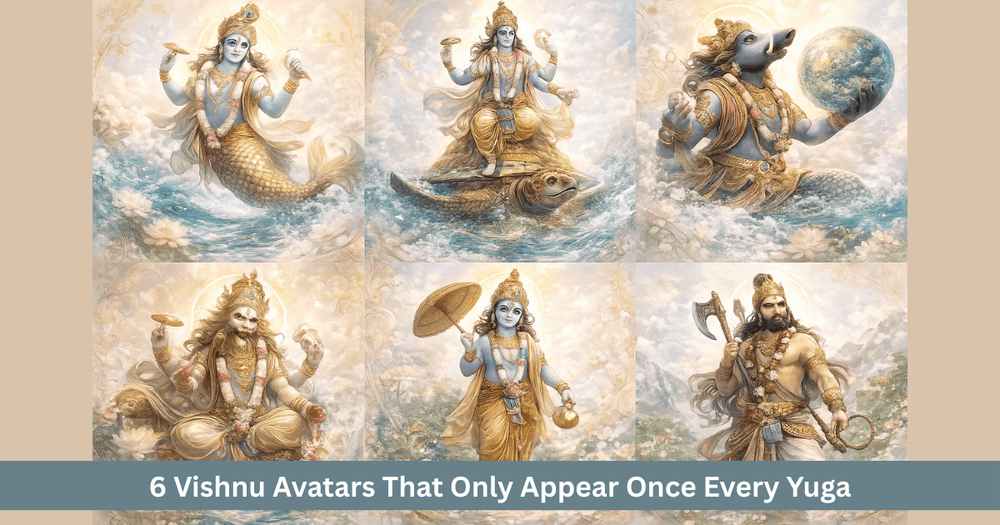
Table of Contents
यदा यदा हि धर्मस्य ग्लानिर्भवति भारत। अभ्युत्थानमधर्मस्य तदात्मानं सृजाम्यहम्॥
"Whenever righteousness declines and unrighteousness rises, I manifest Myself."
- Bhagavad Gita 4.7
At the heart of Hindu cosmology lies a profound understanding of cyclical time and divine responsibility. The universe does not operate under the assumption that creation, once begun, will sustain itself indefinitely. Rather, Hindu philosophy recognizes that cosmic order (dharma) requires active maintenance and when imbalance threatens reality itself, the divine principle of preservation-Vishnu-personally intervenes.
Yet these interventions are not arbitrary or constant. They follow a cosmic schedule as precise as the movements of celestial bodies. Each Yuga (cosmic age) may witness one, two or no avatars-each appearance perfectly timed to address the specific crisis facing that epoch. To understand these rare descents is to recognize that divinity is not distant but intimately involved in the struggle to maintain cosmic order, appearing precisely when needed and departing once the mission concludes.
Among the ten principal avatars of Vishnu (the Dashavatara), six are exceptionally rare-appearing only once per cosmic age, each tailored to address distinct crises that threaten not merely human civilization but the very fabric of reality itself.
The Nature of Rare Avatars: Why Some Appear Once Per Yuga
Understanding Cosmic Intervention
Before exploring individual avatars, we must comprehend why certain incarnations are limited to one appearance per Yuga. Crisis-specific solutions mean each rare avatar addresses a specific cosmic emergency that occurs at predictable intervals. Just as a firefighter appears when there is fire, these avatars manifest precisely when their particular expertise is needed.
Preservation versus continuous presence explains that while some deities remain eternally accessible through prayer, avatars like Matsya and Kurma are physical, temporary interventions marking extraordinary moments when normal spiritual channels are insufficient.
Yuga-based necessity shows that the four Yugas represent progressive stages of cosmic decline, each requiring different forms of divine intervention:
| Yuga | Dharma Level | Primary Crisis | Avatar Response |
|---|---|---|---|
| Satya | 100% | Disruption of cosmic order itself | Matsya, Kurma |
| Treta | 75% | Demonic tyranny, abuse of power | Vamana, Parashurama, Rama |
| Dvapara | 50% | Moral confusion, need for guidance | Krishna |
| Kali | 25% | Widespread unrighteousness | Kalki (prophesied) |
Cosmic efficiency means if avatars appeared constantly, they would lose significance and become routine. Their extreme rarity amplifies their meaning-each appearance announces that the universe faces existential threat requiring divine action.
1. Matsya Avatar: Preservation Through the Flood
The Crisis: When Water Consumed Creation
The Matsya Avatar represents the first of all interventions, occurring at the end of Satya Yuga when the entire cosmos faced annihilation through catastrophic deluge. This was not merely a regional flood but a cosmic event threatening reality's very structure. The oceans overflowed boundaries submerging all land. Mountains dissolved into chaos. Celestial knowledge in the form of the Vedas threatened to vanish forever. Manu, the progenitor of humanity, faced extinction. The entire creation faced being unmade.
Vishnu's Transformation
To address this existential crisis, Vishnu assumed the form of Matsya (fish)-a being perfectly adapted to navigate the flooded cosmos. Vishnu became a giant fish with a spiral horn capable of swimming through the cosmic deluge. The horn served to guide and tether the boat carrying Manu and Vedic knowledge. His fish body allowed navigation through churning waters without being swept away. The scales and fins represented adaptability-the capacity to thrive when environment becomes hostile.
Matsya's role was not to stop the deluge (which was a necessary cosmic reset) but to preserve what was essential: Manu (the wise progenitor carrying the blueprint for human civilization), the Vedas (eternal knowledge encoded in scriptures) and seeds of all plants ensuring biological diversity would survive.
The Deeper Teaching
Matsya illustrates adaptation over resistance, knowledge preservation over physical survival, humility in service (taking the humble form of a fish) and cyclical continuity where destruction leads to transformation. In an age of environmental catastrophe and threats to knowledge preservation, Matsya's mission resonates with digital preservation, biological conservation and adaptability in crisis.
The Singular Nature: Matsya appears only once per Satya Yuga at that specific moment when cosmic deluge threatens creation, emphasizing this crisis occurs at predictable intervals.
2. Kurma Avatar: The Foundation Bearer
The Crisis: Imbalance at Cosmic Transition
The Kurma Avatar emerges at the transition between Satya and Treta Yugas when cosmic order required radical restructuring. The Samudra Manthan (churning of the cosmic ocean) required unprecedented collaboration between gods and demons with a cosmic force of neutrality maintaining balance.
The Mission: The Cosmic Undercarriage
Vishnu assumed the form of Kurma (tortoise) to provide foundation for cosmic restructuring. Mount Mandara, the cosmic axis, was placed upon Kurma's carapace. This placement was absolutely essential-the mountain required stable support to serve as the churning rod. The weight represented combined pressure of cosmic forces attempting restructuring. Kurma's shell provided necessary stability without which the operation would collapse.
The Devas and Asuras pulled upon Vasuki, the serpent wrapped around Mount Mandara. Their opposing forces created churning motion in the cosmic ocean. From this churning emerged 14 treasures including Lakshmi, Amrit and Kamadhenu. The entire operation depended upon Kurma remaining absolutely steady, unmoved by tremendous forces.
The Deeper Teaching
Kurma embodies silent strength, invisible foundation, endurance as virtue, balance maintenance and reverence for cosmic principles of support. Unlike avatars that fight demons or teach philosophy, Kurma simply bears the weight, teaching that true strength often operates silently without recognition.
The Singular Nature: Kurma appears only once per Yuga transition at that precise moment when cosmic restructuring requires stable foundation.
3. Vamana Avatar: Wisdom Over Brute Force
The Crisis: Tyranny Through Legitimate Victory
The Vamana Avatar appears in Treta Yuga to address a unique crisis: a demon king who gained legitimate universal control through merit and penance, creating a situation where defeating him through force would violate cosmic law. King Bali had earned his position through dharma, yet his excessive pride and misuse of authority created imbalance. The gods could not simply destroy him without violating universal law.
Vishnu's Elegant Solution
Vishnu manifested as Vamana, a small Brahmin boy appearing before King Bali. Vamana appeared as a humble child, not a warrior or threat. He approached Bali with respectful politeness asking for a simple boon: three paces of land. To a king ruling the entire universe, three paces seemed trivial.
Once Bali granted the boon, Vamana revealed his cosmic form. In one vast stride, the avatar covered the entire earth. In the second stride, he covered all the heavens. For the third stride, there was no space remaining. Rather than using the third stride as a weapon, Vamana placed his foot on Bali's head-not violently but symbolically of true cosmic order. Bali was not destroyed but humbled and sent to the netherworld with the honor of having divine presence upon his head.
The Deeper Teaching
Vamana illustrates honesty as strategy, subtlety over force, intelligence as divine quality, recognition through humility, justice without violence and respecting earned authority. The crisis was resolved without killing yet perfect cosmic justice was achieved.
The Singular Nature: Vamana appears only once per Treta Yuga when excessive pride threatens to corrupt legitimate power.
4. Parashurama Avatar: The Warrior-Sage's Correction
The Crisis: Corruption of the Warrior Class
The Parashurama Avatar emerges in Treta Yuga to address systematic abuse of power by the Kshatriya class, violation of dharma by those meant to uphold it and exploitation of the weak by the strong. Many warrior-kings had become corrupt, abusing power to exploit people, violating sacred duties, challenging spiritual authority and inverting natural order.
Vishnu's Fierce Incarnation
Vishnu manifested as Parashurama (literally "Rama with an axe")-a unique avatar combining warrior ferocity with sage wisdom. The axe symbolized cutting force, destruction of corruption and swift justice. The sage aspect equipped him with spiritual wisdom and deep understanding of dharma. Parashurama traveled the earth identifying and eliminating corrupt kings, performing this task twenty-one times, systematically purging the warrior class. After completing his mission, he retired to Mount Mahendra, withdrawing from public life.
The Deeper Teaching
Parashurama illustrates divine anger as purification, correction versus destruction, warrior dharma restored, no compromise with dharma, withdrawal after mission and the necessity of enforcement. While other avatars work through wisdom or love, Parashurama reminds us that dharma sometimes requires enforcement.
The Singular Nature: Parashurama appears only once per Treta Yuga when warrior class corruption becomes so severe that swift correction is the only remedy.
5. Rama Avatar: The Ideal Made Manifest
The Crisis: Loss of Moral Exemplars
The Rama Avatar emerges in Treta Yuga to address a different crisis: the absence of moral exemplars. When no being exists who embodies perfect balance of duty, compassion, righteousness and devotion, society loses its north star. As Treta Yuga progresses toward Dvapara, cosmic decline creates confusion about what dharma actually requires.
Vishnu's Perfect King
Vishnu manifested as Rama, who appears as the ideal human being. As a son, Rama honored his parents accepting exile to keep his father's word. As a husband, Rama loved Sita with devotion yet made heartbreaking decisions when dharmic duty required. As a warrior, Rama defeated Ravana through discipline, strategy and righteousness. As a king, his reign Rama Rajya became the ideal model of governance. As a teacher, his life and the Ramayana provide guidance on every aspect of life.
The Ramayana serves as a manual for dharmic living, dealing with family obligations conflicting with personal happiness, navigating betrayal without losing righteousness, balancing love with duty, making moral decisions under impossible circumstances, understanding dharma sometimes requires personal sacrifice and maintaining compassion even toward enemies.
The Deeper Teaching
Rama illustrates duty as love, righteousness over comfort, complexity of moral life, consequences of dharma, universal applicability and the eternal model. Rama does not merely solve a crisis and depart; his life becomes eternal teaching applicable to every generation.
The Singular Nature: Rama appears only once per Treta Yuga when decline of dharma has created confusion about what righteousness actually looks like in practice.
6. Krishna Avatar: The Supreme Guide
The Crisis: Moral Complexity and Philosophical Confusion
The Krishna Avatar manifests in Dvapara Yuga to address the most complex crisis: moral confusion, conflicting dharmas and inability to discern right action when all options seem compromised. Unlike Treta Yuga with relatively clear dharmic principles, Dvapara Yuga experiences collision of competing dharmas where duty to family conflicts with duty to righteousness, following established codes seems to lead to unrighteousness and individuals face genuine moral paralysis.
The Mahabharata war exemplifies this crisis. The Pandavas have just claims yet fighting cousins violates family dharma. Arjuna is a warrior with duty to fight yet killing relatives creates spiritual pollution. Following rules seems to require tolerating cheating. Non-action would allow injustice to triumph. Every choice seems to compromise dharma.
Vishnu's Supreme Teacher
Vishnu manifested as Krishna, appearing as the ultimate multidimensional guide. As a diplomat, Krishna negotiates and attempts to prevent war through every means. As a strategist, when war becomes necessary Krishna provides strategic guidance ensuring victory for righteousness. As a philosopher, through the Bhagavad Gita Krishna teaches Arjuna how to navigate moral complexity. As a lover, through pastimes with Radha and the gopis Krishna demonstrates divine love is ultimate reality. As a divine trickster, sometimes breaking rules to maintain ultimate dharma. As a flute player, reminding humanity that joy and celebration are aspects of the divine.
The Bhagavad Gita: Heart of Krishna's Teaching
When Arjuna faces moral paralysis before battle, Krishna delivers the most comprehensive spiritual teaching in Hindu scripture addressing the nature of duty (swadharma), detachment with action (nishkama karma yoga), paths to the divine through knowledge, devotion, action or meditation, the nature of the Self where consciousness is eternal, divine responsibility where dharma sometimes requires seemingly unrighteous actions, universal accessibility where the divine is accessible to all through sincere effort and immortality through remembrance.
The Deeper Teaching
Krishna illustrates complexity as truth, levels of teaching (different lessons to different people), non-dualism where ultimate reality transcends apparent opposites, divine play (lila) suggesting creation is divine celebration, bhakti as the ultimate path, ethical relativism within absolute dharma and immortality through remembrance. Krishna promises that anyone who remembers him with sincere heart will achieve immortality.
The Multifaceted Intervention
Unlike other avatars with specific missions, Krishna's intervention operates on multiple levels: political (prevent war through diplomacy), military (ensure victory for righteousness), philosophical (clarify dharmic confusion through Bhagavad Gita), spiritual (reveal divine nature through cosmic form), personal (inspire devotion through love) and cultural (preserve wisdom through stories).
| Level | Mission | Method |
|---|---|---|
| Political | Prevent war through diplomacy | Negotiation, though ultimately unsuccessful |
| Military | Ensure victory for righteousness | Strategic guidance to the Pandava armies |
| Philosophical | Clarify religious confusion | Teach Bhagavad Gita to Arjuna |
| Spiritual | Reveal divine nature | Direct manifestation of cosmic form |
| Personal | Inspire devotion | Love and intimacy with devotees |
| Cultural | Preserve knowledge | Stories and teachings passed through generations |
The Singular Nature: Krishna appears only once per Dvapara Yuga when moral complexity requires philosophical depth and multidimensional guidance.
The Prophesied Tenth: Kalki Avatar
The Avatar Yet to Come
Hindu scriptures prophesy a tenth avatar, Kalki, destined to appear at the end of Kali Yuga-our current age. At the end of Kali Yuga when dharma has declined to minimum and unrighteousness dominates all spheres, Kalki will manifest on a white horse representing purity amid corruption, armed with a blazing sword representing divine judgment. His mission will be to destroy the wicked and re-establish dharma, cleansing the world and ushering in a new Satya Yuga.
Unlike other avatars who work within the existing age to maintain balance, Kalki will end the current age itself, demonstrating that cosmic cycles are finite and ultimate renewal requires radical transformation.
Conclusion: The Pattern of Divine Presence
The Rhythm of Intervention
When examined together, these rare avatars reveal a coherent pattern: Satya Yuga focuses on preservation (Matsya, Kurma) preventing total collapse of reality. Treta Yuga emphasizes correction and guidance (Vamana, Parashurama, Rama) restoring order and providing moral examples. Dvapara Yuga provides wisdom and teaching (Krishna) navigating moral complexity. Kali Yuga will bring ultimate renewal (Kalki) ending the cycle and beginning anew.
Each avatar is precisely calibrated to the crisis of their age, appearing only when needed and operating through methods appropriate to that crisis.
The Philosophical Depth
These avatars teach that reality is not autonomous but requires conscious maintenance of dharmic balance. Divine intervention is purposeful and measured, not arbitrary or constant. Different crises require different solutions. The divine takes forms appropriate to the task. Rarity amplifies significance-these avatars matter precisely because they appear only once per age.
The Contemporary Resonance
In our current Kali Yuga, knowledge of these rare avatars serves several purposes: historical perspective showing cosmic crises have occurred before and been resolved, philosophical grounding suggesting cosmic forces work toward restoration of balance, moral aspiration where Rama's example and Krishna's wisdom provide reference points and hope and resilience where the prophecy of Kalki and subsequent Satya Yuga suggests decline is not permanent.
Final Reflection
The six rare avatars described here-Matsya, Kurma, Vamana, Parashurama, Rama and Krishna-represent Hinduism's most profound answer to the question: "How does the divine engage with reality's suffering?" The answer is not that suffering is prevented but that suffering is not meaningless. Each crisis calls forth appropriate response. Each age receives precisely the guidance it needs. Each being-whether fish, tortoise, dwarf, warrior, perfect king or supreme teacher-manifests the aspect of divinity most needed in that moment.
As we navigate our own age's complexities, we might take comfort in recognizing ourselves as participants in a cosmic drama as old as existence itself. The avatars remind us that we are not abandoned to chaos, that divine response to crisis is reliable and that even in Kali Yuga's darkness, a single devoted heart can connect with the divine presence that has always and will always, appear precisely when the universe calls.
The pattern continues. The dance of divine presence and cosmic necessity persists. And though Kalki has not yet descended from the heavens, the prophecy reminds us that the final chapter has already been written-not as an ending but as a transition to a new beginning, as eternal and cyclical as time itself.
Frequently Asked Questions
Why do only six of Vishnu's ten avatars appear once per Yuga?
Of the ten avatars, Matsya, Kurma, Vamana, Parashurama, Rama and Krishna appear only once per Yuga because each addresses a specific cosmic crisis occurring at predictable but long intervals. Matsya appears during cosmic deluge. Kurma provides stability during Yuga transition. Vamana addresses corruption of legitimate power. Parashurama corrects systematic warrior class corruption. Rama addresses absence of moral exemplars. Krishna navigates moral complexity and philosophical confusion. The specificity of these crises means these avatars are only necessary at those precise moments. Other avatars like Varaha or Narasimha address specific villains or situations that can occur multiple times, whereas these six address one-time events in the cosmic cycle.
Why are Matsya and Kurma avatars particularly significant?
Matsya and Kurma are particularly significant because they appear in Satya Yuga when crises threaten cosmic order itself, not merely moral or social problems. Matsya preserves essential knowledge and life during destruction of entire creation, ensuring the next cycle can begin. Kurma provides foundation during Samudra Manthan when the universe is being restructured. These avatars demonstrate that divine intervention is not only about human morality but about maintaining the continuity of reality itself. Their animal forms-fish and tortoise-are also significant. They show the divine will take any form, however humble, to maintain cosmic order. moreover both are aquatic creatures connected to the primordial water element from which all creation emerges.
What is the difference between Rama and Krishna avatars if both are great teachers?
While both Rama and Krishna are great teachers, they address fundamentally different crises and use different methods. Rama appears in Treta Yuga when moral exemplars are needed. He is Maryada Purushottam-the ideal person who teaches through his life. Rama's teaching is about following clear dharmic principles even when it causes personal suffering. Krishna appears in Dvapara Yuga when moral complexity and philosophical confusion dominate. He is Yogeshwar-the divine strategist and philosopher who teaches that dharma applies based on context. Krishna's teaching is about understanding that sometimes breaking rules is necessary to maintain the spirit of dharma. Rama follows rules; Krishna transcends them. Rama is tragic; Krishna is joyful. Rama represents humanity's best; Krishna reveals divinity's fullness. Both are necessary-Rama for when dharma is clear but difficult, Krishna for when dharma itself is unclear.
What do the prophecies say about the Kalki avatar?
The prophecies about Kalki avatar are found in the Kalki Purana, Vishnu Purana and Bhagavata Purana. They state that at the end of Kali Yuga, when dharma has nearly vanished and adharma dominates everywhere, Kalki will appear riding a white horse named Devadatta. He will be born in Shambhala village to a Brahmin named Vishnuyashas. Armed with a blazing sword, he will destroy the wicked and re-establish dharma. Some texts say he will learn martial arts from Parashurama, who is still alive and meditating on earth. Kalki's mission is to end the current age and initiate a new Satya Yuga, restarting the cycle. Some interpretations view Kalki literally, while others see him symbolically as representing ultimate spiritual transformation that will purify humanity. The prophecy provides hope that regardless of how degraded the current age becomes, divine intervention will eventually restore cosmic order.
What do these rare avatars teach modern spiritual seekers?
These rare avatars teach modern seekers several profound lessons. First, divine intervention is reliable but purposeful-during times of crisis, even when things seem hopeless, cosmic forces are working to restore balance. Second, different problems require different solutions-there is no one-size-fits-all spiritual approach. Third, the divine takes any form necessary-this humility, from humble fish to philosopher king, teaches that there is no ego in service. Fourth, moral complexity requires wisdom, not merely following rules-both Rama and Krishna show that dharma is context-sensitive. Fifth, cyclical time means decline is not permanent-the prophecy of Kalki provides hope that however bad things become, renewal will eventually come. Sixth, bhakti is accessible to all-Krishna teaches that simple devotion can be the most powerful spiritual practice. Seventh, we are participants in cosmic drama-recognizing ourselves as part of eternal patterns larger than individual life provides perspective and resilience.
What is the time period between Yugas and where are we currently?
Hindu cosmology describes four Yugas that repeat cyclically. Satya Yuga lasts 1,728,000 years where dharma is at 100 percent. Treta Yuga lasts 1,296,000 years where dharma falls to 75 percent. Dvapara Yuga lasts 864,000 years where dharma is at 50 percent. Kali Yuga lasts 432,000 years where dharma is only 25 percent. According to Hindu calculation, we are currently in Kali Yuga, which began approximately 3102 BCE when Krishna left the earth. This means we are about 5,000 years into this age, with approximately 427,000 years remaining. Some traditions suggest we are in a special period within Kali Yuga where spiritual practices are particularly powerful. At the end of Kali Yuga, Kalki will appear, end the age and initiate a new Satya Yuga. These vast time scales remind us that Hindu thought operates on cosmic scales where human lifespans are moments in cosmic cycles.
What does Nakshatra reveal about me?
My NakshatraDid you like it?
Author

Pt. Abhishek Sharma (63)
Experience: 20
Consults About: Family Planning, Career
Clients In: Punjab, Haryana, Delhi
Share this article with friends and family
About ZODIAQ
ZODIAQ is an online Vedic Astrology platform. It connects clients seeking astrological advice to experienced astrologers with deep knowledge. Our users also generate kundali and perform kundali milan for free. ZODIAQ also offers services to the Astrologers. Astrologers utilize various offerings by ZODIAQ to serve their clients effectively.
If you are a User
Consult with experienced astrologers and seek their guidance. You can also order handwritten Janm Patrika report with life prediction prepared by experienced astrologers. Generate accurate Kundali, perform Kundali Matching and check horoscope and muhurat. Utilize our online library for all the necessary astrological and spiritual information.
If you are an Astrologer
Create accurate kundali for your clients and perform Kundali Matching for up to 5 people at a time. Write comprehensive Janm Patrika report for your clients with ZODIAQ. Check client details anytime by saving it in client directory. Become more productive by tracking how many clients you guide every day.
WELCOME TO
ZODIAQ
Right Decisions at the right time with ZODIAQ
500+
USERS
100K+
TRUSTED ASTROLOGERS
20K+
DOWNLOADS
