Detailed Symbolism of Ganesha’s Form and the Life Lessons
By Pt. Amitabh Sharma
From Ganesha’s birth story to his modak, serpent, mouse and single tusk, each detail embodies wisdom
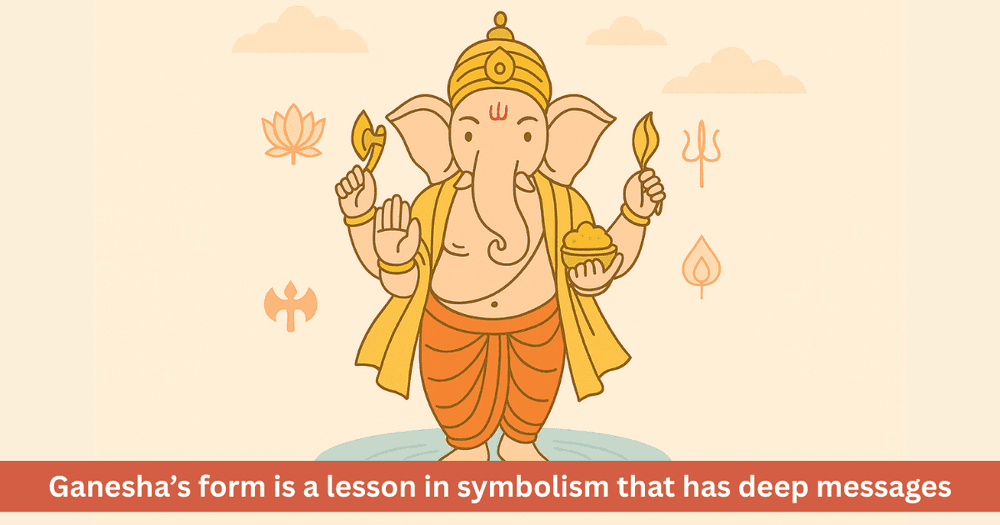
Table of Contents
Why was Ganesha’s form expressed through symbols
The figure of Lord Ganesha is no ordinary idol, it is a living map of wisdom. Every single aspect of the imagery was chosen with foresight by ancient seers. They used symbols and not words to express truth because symbols never lose their essence. Languages mutate, interpretations change and words lose meaning but symbols shine through generations. His large ears teach us to listen carefully, the trunk shows flexibility, the big belly teaches conscious acceptance and the mouse demonstrates how vast consciousness can be channelled through subtle means. Ganesha’s form is, in truth, a human curriculum delivered through divine art.
What meaning lies in the story of Ganesha’s birth
Parvati created a boy out of the dirt removed from her body and set him as guard while she bathed. Shiva returned, was stopped by him and angered, cut off the boy’s head. Parvati, inconsolable, pleaded and Shiva replaced the head with that of a north facing elephant. Thus Ganesha was born.
Read literally, the story provokes confusion. Why should a goddess have dirt? How can a father fail to recognise his son? Why adopt an elephant’s head? But as an allegory, the message is rich. Parvati symbolises energy and festivity. Dirt signifies ignorance. Celebration without serenity breeds feverishness and takes one away from the centre. The boy blocking Shiva symbolises ignorance denying entry to wisdom. Shiva, representing pure knowledge, severs the head of ignorance. The elephant head facing north represents wisdom and foresight. The term “Uttara” in Sanskrit means both north and answer. To give him such a head means the boy has now become the answer himself. The allegory turns absurdity to instruction and the child into the very form of awakened wisdom.
What does the modak stand for
The modak that Ganesha holds is not a sweetmeat offered casually. Its deeper essence is joy, prosperity and spiritual fulfilment. When life is filled with knowledge, happiness is natural. Obstacles appear manageable and struggles become lessons. Modak reminds us that real prosperity lies not in wealth but in contentment born of wisdom.
What message is in Ganesha’s big belly
Among Ganesha’s many features, his large belly is one of the most significant symbols. It illustrates conscious acceptance. The belly is the seat where joy, sorrow, insult and praise can all be contained. The serpent coiled around it ensures the acceptance is not dull but alert. Acceptance without vigilance becomes indulgence but acceptance with awareness becomes mastery. Tradition explains that Ganesha digests even negativity. He absorbs energy from the world and transforms it into peace. His belly teaches that wisdom lies not in rejecting experiences but in receiving them with balance and discipline.
What do Ganesha’s hand gestures reveal
The Abhaya mudra shows freedom from fear. The Varada mudra indicates bestowal of blessings. Together they highlight that both fearlessness and joy arise from within and are awakened through worship. His serene smile and playful nature further remind us that true joy belongs only to those established in wisdom.
Why is the Chaturthi moon significant
The Chaturthi moon represents the restless, limited mind. It quickly dismisses and fails to grasp deeper truths. Ganesha striking it represents the integration of even the small mind into the wholeness of divinity. Seers advise seekers not to be led by the flickering mind but by intellect and intuition. The moon thus symbolises caution and integration.
What wisdom does the Ekadanta form give
One tusk makes Ganesha unique. Ekadanta means the one with a single tusk and it represents one pointed focus and clarity. Two tusks symbolise chewing externality, duality and conflicts. One tusk is transcendence; for the realised, the world is already within. No external remains to process. Ganesha therefore symbolises singular clarity and determination.
Why does Ganesha hold Paasha and Ankusha
In his hands are the noose and the goad. These are not about conquering others but mastering oneself. The goad arouses the inner power, Kundalini Shakti. The noose restrains. Energy without restraint is destructive. Restrained energy uplifts and liberates. Paasha and Ankusha remind seekers that force alone is futile but force disciplined by wisdom creates harmony, growth and inner liberation.
Why is his vehicle the humble mouse
The mouse is too small compared to Ganesha’s enormous frame and yet is chosen carefully. It denotes the mantra, small in syllables but containing vast power. It also represents inquiry. A small question like “Who am I?” can open immeasurable paths of realisation. Just as science encodes great laws into concise formulae, spirituality prompts vast experiences through small sutras. The mouse is a reminder that humility and inquiry are essential to wisdom.
What does the north facing elephant head represent
The elephant head, specifically facing the north, is mentioned in the tale. This is deeply symbolic. Uttara meaning north also implies answer. The north-facing elephant head means Ganesha now holds the answers for all seekers’ questions. Wisdom is foresight and without it, the mind suffers restless confusion. With wisdom, it rests calm and fearless.
What essence of Ganapati was revealed by Adi Shankaracharya
Adi Shankaracharya’s Ganapati Atharvashirsha describes Ganesha not as one deity among many but as the very essence of the Divine. He is Brahma, Vishnu, Shiva, Indra. He is pure consciousness, bliss, knowledge, seed and fruit. He is described as beyond all qualities yet the lord of all virtues. Specialness implies limitation. Ganesha is not special, he is supreme ordinary and infinite together, the Parabrahma himself.
What devotional teaching emerges from Ganesh Chaturthi
The festival of Ganesh Chaturthi is not a ritual of fear or bargaining. It is celebration, gratitude and love. The clay idol is a medium only. We invite divinity into our home for a while to adore it and express devotion. When the immersion comes, we dissolve the idol, reminding us that divinity is not cemented to the idol but exists within us. The offerings we make are nothing but what God already gave us. A true devotee desires not gifts but the Lord himself. Ganesh Chaturthi thus awakens the Ganapati within, the force of clarity that removes inner obstacles.
What is life’s real celebration according to Ganesha
Establishing the idol, worshipping with love for days, then immersing it back into the waters is a metaphor for life itself. Birth, living, death and liberation are all symbolised. The essence is not the clay or the ritual but the awakening within. The true Ganapati resides in our consciousness. To seek knowledge, to live with joy, to face life fearlessly and to embrace wisdom - that is the real celebration.
Frequently Asked Questions
Q: What does the modak in Ganesha’s hand symbolise
A: It represents joy, prosperity and fulfilment. It means inner happiness arising from wisdom filled consciousness, not from possessions.
Q: Why is Ganesha’s vehicle a mouse
A: The mouse stands for mantra and inquiry. Simple seeds open vast realisations. A small mantra or question can lead to infinite consciousness.
Q: What lesson is symbolised in the single tusk of Ganesha
A: It teaches single pointed focus and clarity. Ekadanta also means the only giver. For the enlightened, duality dissolves and clarity alone remains.
Q: What is the meaning of Paasha and Ankusha in his hands
A: The goad is awakening, the noose is restraint. The union of the two conveys balance - energy guided by wisdom.
Q: What does Visarjan remind us in Ganesha’s worship
A: It reminds us that God is not outside in form only but within. Dissolving the idol is an instruction to awaken Ganapati in our hearts.
What does Nakshatra reveal about me?
My NakshatraDid you like it?
Author
Pt. Amitabh Sharma (56 Years)
Experience: 20
Consults About: Family Planning, Career
Clients In: Punjab, Haryana, Delhi
Share this article with friends and family
About ZODIAQ
ZODIAQ is an online Vedic Astrology platform. It connects clients seeking astrological advice to experienced astrologers with deep knowledge. Our users also generate kundali and perform kundali milan for free. ZODIAQ also offers services to the Astrologers. Astrologers utilize various offerings by ZODIAQ to serve their clients effectively.
If you are a User
Consult with experienced astrologers and seek their guidance. You can also order handwritten Janm Patrika report with life prediction prepared by experienced astrologers. Generate accurate Kundali, perform Kundali Matching and check horoscope and muhurat. Utilize our online library for all the necessary astrological and spiritual information.
If you are an Astrologer
Create accurate kundali for your clients and perform Kundali Matching for up to 5 people at a time. Write comprehensive Janm Patrika report for your clients with ZODIAQ. Check client details anytime by saving it in client directory. Become more productive by tracking how many clients you guide every day.
WELCOME TO
ZODIAQ
Right Decisions at the right time with ZODIAQ
500+
USERS
100K+
TRUSTED ASTROLOGERS
20K+
DOWNLOADS
