Samudra Manthan and Kamadhenu: The Myth Behind the Cow of Abundance
By Pt. Amitabh Sharma
The Ocean That Promised Everything
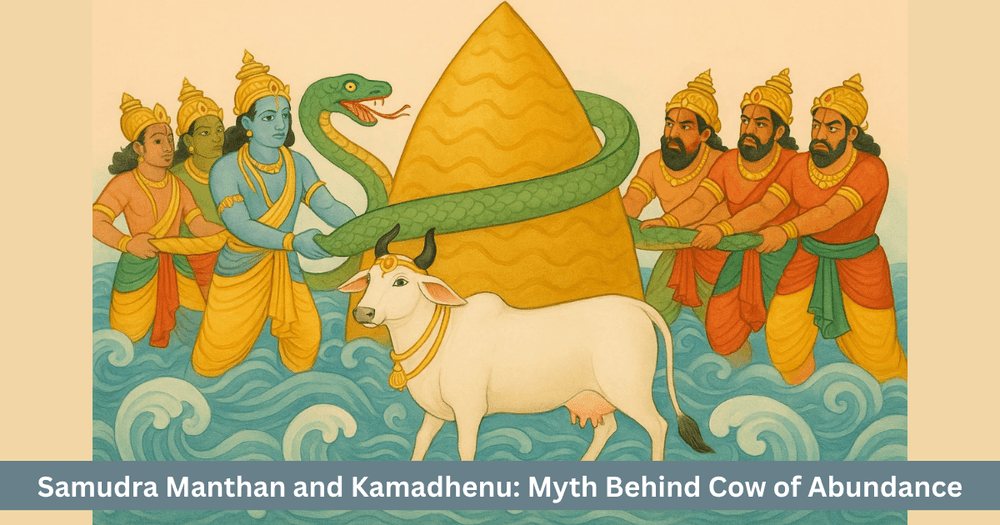
Table of Contents
The Ocean That Promised Everything
In the ancient chronicles of Hindu mythology, few events rival the cosmic grandeur of Samudra Manthan-the churning of the primordial ocean. This was not merely a quest for treasure but a desperate struggle for existence itself, a collaboration born of necessity between sworn enemies: the Devas (celestial gods) and the Asuras (powerful demons). Both factions shared a singular, consuming desire: immortality. They knew that somewhere within the unfathomable depths of the cosmic ocean lay Amrit (ambrosia), the nectar of eternal life-a substance so potent it could transcend death, disease and the very limitations of mortal existence. But extracting this divine elixir would require unprecedented effort, cooperation and sacrifice. The ocean would not yield its secrets easily. This was a journey destined to shake the very foundations of the universe and birth numerous wondrous treasures in the process.
The Grand Apparatus of Creation and Preparation for Churning
To accomplish this monumental task, the gods and demons assembled tools of cosmic proportions. Each component was carefully chosen and each had its own crucial role that was indispensable for the success of this extraordinary endeavor.
Mount Mandara served as the churning rod. This mountain was of such immense size and weight that it could stir the ocean's primordial depths, agitating forces dormant since creation's dawn. The choice of this mountain was made due to its immense stability and firmness. Vasuki, the great serpent king, volunteered to become the churning rope. His massive body was wrapped around the mountain, creating the mechanism by which the churning could proceed. Lord Vishnu took the form of Kurma (tortoise avatar), the cosmic turtle, diving beneath the ocean to support Mount Mandara on his back, preventing it from sinking into the abyss under its own crushing weight.
The Devas grasped Vasuki's tail. The Asuras, in their pride, insisted on holding the serpent's head, unknowingly condemning themselves to inhale the poisonous fumes that would soon pour from Vasuki's mouth as the churning intensified. And then, with divine coordination and demonic determination, the churning began. This was a spectacle unprecedented in all three worlds, where enemies worked together toward a common goal.
When Creation Trembled and Poison Emerged
The ocean, which had rested in peaceful equilibrium since time immemorial, began to convulse violently. This was not mere turbulence but a tremor that spread throughout the entire universe. Waves transformed into towering whirlpools that threatened to swallow the earth. Lightning cracked across the sky, as if the universe itself protested this disturbance. The foundations of reality shook, cosmic forces awakening from their slumber. Terrible poison emerged first-the Halahala, so toxic it threatened to annihilate all creation.
In that moment of supreme crisis, Lord Shiva intervened. He consumed the deadly poison and held it in his throat, which turned blue, earning him the name Neelkanth (the blue-throated one). Thus he saved existence from premature extinction. Only after this near-catastrophe could the treasures begin to emerge. This moment demonstrates that the greatest gifts can only be received after facing the most difficult trials. Shiva's sacrifice and courage were essential for the survival of creation.
The Significance of Poison and Shiva's Grace
The Halahala poison was not merely an obstacle but a test. It demonstrated that dangers and challenges would appear on the path to great achievements. Lord Shiva's drinking of the poison teaches that true sacrifice means putting oneself in danger for the welfare of others. Shiva saved not only the gods and demons but all of creation from destruction. His blue throat forever reminds us of this sacrifice. It also shows that even in the darkest moments, divine help is available if our purpose is pure and righteous.
The Gifts That Rose from the Depths: Wonders Beyond Imagination
As the churning continued with renewed vigor, the ocean-having released its darkness-began yielding treasures of breathtaking beauty and power. Each treasure represented fundamental aspects of cosmic abundance.
List of Divine Treasures and Their Significance
| Treasure | Symbolism | Recipient and Significance |
|---|---|---|
| Lakshmi | Wealth, beauty, grace, prosperity | Chose Vishnu as her eternal consort |
| Airavata | Strength, majesty, royal power | Became Indra's celestial mount |
| Kalpavriksha | Wish-fulfillment, spiritual abundance | The tree that grants all desires |
| Varuni | Joy, celebration, intoxication | Goddess of wine and spiritual ecstasy |
| Chandra | Time, cycles, emotional wisdom | The moon that measures months and tides |
| Kaustubha | Divine beauty, spiritual attraction | The jewel adorning Vishnu's chest |
| Parijata | Heavenly fragrance, divine beauty | The celestial coral tree |
| Apsaras | Art, dance, celestial pleasure | Divine dancers who enchant the heavens |
| Ucchaisravas | Speed, power, divine grace | The seven-headed white horse |
| Dhanvantari | Ayurveda, medicine, health | Emerged holding the pot of Amrit |
Amidst these spectacular manifestations of cosmic abundance emerged Kamadhenu-the divine cow who would become the very embodiment of selfless giving. Each treasure brought with it a teaching, a virtue essential for humanity.
The Deeper Meaning of the Treasures
Lakshmi's arrival shows that prosperity and beauty manifest when we work hard. Airavata symbolizes strength and dignity that supports righteous leadership. Kalpavriksha teaches that when we keep our desires pure, the universe is ready to fulfill them. The moon represents the cyclical nature of time and reminds us that everything is changeable. The Apsaras demonstrate the importance of art and beauty that give meaning to life. Ucchaisravas symbolizes speed and agility necessary for progress.
The Birth of Kamadhenu: Grace Incarnate
Unlike the dramatic arrivals of other treasures-the dazzling beauty of Lakshmi, the thunderous emergence of Airavata, the brilliant radiance of Chandra-Kamadhenu's appearance was marked by gentleness. This was an arrival that touched the heart, not one that dazzled the eyes.
The Cow Unlike Any Other
Kamadhenu manifested with qualities that set her apart. She was not fierce like the gods who battled for supremacy. She was not ambitious like the demons who schemed for advantage. She was not dazzling like Lakshmi who captured all eyes with her radiance. She was not imposing like Airavata who commanded through physical majesty. Instead, she embodied pure grace. Her presence was so serene that the chaos of churning seemed to still in her vicinity. Her very existence calmed the turbulent forces surrounding her.
The Name That Reveals Nature
The name Kamadhenu carries profound meaning within its syllables. Kama means desire, wish, fulfillment. Dhenu means cow, milk-giver, nurturer. Thus her name translates to "the cow who fulfills all desires." But this translation barely scratches the surface of her deeper significance. Kamadhenu is not merely about material wish-fulfillment but represents spiritual completeness.
Beyond Material Fulfillment
Kamadhenu's story transcends simple material abundance. She represents a truth that the battling gods and demons were only beginning to comprehend: True abundance is not about possessing everything but about the capacity to share what you have. Her milk was said to nourish the heavens themselves-not through hoarding or selective distribution but through an endless, generous flow that sustained all who approached with genuine need and reverence. Her arrival served as a cosmic reminder that creation is not merely about the accumulation of power but about the cultivation and expression of compassion.
Kamadhenu's presence also taught that the greatest power can reside in gentleness. While other treasures impressed with their strength and brilliance, Kamadhenu attracted everyone through her unlimited capacity to give. This shows that true greatness lies not in force but in service and dedication.
Kamadhenu and Sage Vashishta: Devotion Over Domination
After emerging from the cosmic ocean, Kamadhenu eventually found her spiritual home in the ashram of Sage Vashishta. Vashishta was one of the Saptarishis (seven great sages) and the royal guru to the Ikshvaku dynasty. This pairing was not accidental but part of divine arrangement.
Sacred Partnership and Service
In Vashishta's ashram, Kamadhenu fulfilled numerous important roles. She provided everything needed for sacred rituals. Milk, ghee, curd and other essentials that were indispensable for yajnas (fire sacrifices) and worship. She nourished countless students and visitors who came to study under the great sage. She demonstrated perfect service without expectation of reward or recognition. She embodied the principle that true wealth lies in supporting spiritual pursuits. Kamadhenu's presence in Vashishta's ashram filled the atmosphere with divinity and peace.
When Kings Coveted Her
The most famous episode involving Kamadhenu concerns King Vishwamitra. Vishwamitra was a powerful warrior-king who visited Vashishta's ashram and witnessed Kamadhenu's miraculous abundance. Overwhelmed by desire to possess such power, he made various attempts. He offered to purchase Kamadhenu with vast treasures. When refused, he attempted to seize her by force. He commanded his armies to capture the divine cow. This was a moment that was destined to demonstrate the clash between power and dharma.
But Kamadhenu, despite her gentle nature, demonstrated hidden strength. At Vashishta's request, she created entire armies from her own body. She gave birth to warriors to defend herself. She defeated Vishwamitra's forces without leaving her spiritual home. This demonstrated that devotion to dharma provides protection no weapon can match.
The Deeper Teaching and Vishwamitra's Transformation
This confrontation revealed profound truths. Strength does not always manifest as obvious power. Kamadhenu's might lay dormant until needed, activated only in defense of dharmic principles. Spiritual treasures cannot be possessed through force. Vishwamitra's royal authority and military strength proved useless against a power rooted in devotion and righteousness. True abundance chooses its home. Kamadhenu refused to leave Vashishta's ashram not from compulsion but from genuine spiritual affinity-she resided where she was honored, not where she might be exploited.
This episode eventually became a turning point for Vishwamitra himself. Humbled by his defeat, he renounced his kingdom and undertook severe austerities that ultimately transformed him from a warrior-king into one of the greatest sages in history. Thus Kamadhenu not only defended herself but also made possible the transformation of a soul.
Kamadhenu: The Mother of Plenty
Beyond her individual story, Kamadhenu occupies a unique position in Hindu spiritual and cultural consciousness. She is the archetypal mother, the ultimate nurturer whose giving knows no bounds.
Symbol of Earth's Generosity
Kamadhenu represents numerous profound concepts. She is a symbol of the earth itself, which provides food, shelter and resources without demanding repayment. She represents the principle of sustainable abundance, where giving does not deplete but actually increases capacity. She is the embodiment of maternal love, which nourishes without calculation or condition. She symbolizes nature's cyclical generosity, the eternal return of seasons, harvests and renewal. Kamadhenu teaches us that the act of giving itself is a reward and that what is given returns multiplied.
Every Cow as Her Descendant
In Hindu tradition, every cow is considered a descendant and manifestation of Kamadhenu. This explains the sacred status of cows throughout Indian culture. The prohibition against harming cattle. The ritual importance of cow products in religious ceremonies. The traditional respect shown to cows as embodiments of divine giving. This is not mere animal worship but recognition of a deeper principle: honoring the creatures and forces that sustain life without asking anything in return.
The Five Sacred Products and Their Significance
Kamadhenu gives the Panchagavya (five products of the cow). Each has spiritual and practical significance.
| Product | Symbolism | Use and Importance |
|---|---|---|
| Milk | Nourishment, purity, sustenance | Food, rituals, health |
| Curd | Transformation, beneficial change | Digestion, cooling, worship |
| Ghee | Sacred fuel, illumination | Yajnas, lamps, medicine |
| Urine | Purification, medicinal properties | Cleaning, healing, agriculture |
| Dung | Fertility, fuel, building material | Fertilizer, fuel, construction |
Together, these represent the complete cycle of giving. Every aspect of the cow's existence provides value, nothing is wasted, all contributes to sustaining life. This teaches that nothing in nature is useless and each element has its own purpose and value.
The Ocean's Deeper Message: Life as Churning
The story of Samudra Manthan transcends mythology to become a profound metaphor for human existence. It teaches us that life itself is a continuous churning.
We All Churn Our Own Oceans
Each person navigates their own version of the cosmic ocean. The depths of emotion which include joy and sorrow, love and fear. The waves of ambition where dreams are pursued and obstacles encountered. The ocean of uncertainty where there are questions without easy answers. The process of transformation where old identities die and new understanding is born. Every stage of life is a type of churning that transforms us.
The Process Is Messy and Painful
Just as the churning produced deadly poison before yielding treasures, our lives too are filled with difficulties. Growth often hurts before it heals. Transformation requires the dissolution of familiar patterns. Wisdom emerges from confusion and struggle. Beauty rises from chaos and conflict. Each difficulty is actually a hidden gift that has come to make us stronger.
Persistence Brings Hidden Treasures
The gods and demons could not know what would emerge next, yet they continued churning. Similarly, our lives are filled with uncertainty. We cannot predict what our struggles will produce. Faith sustains effort when outcomes remain uncertain. The process itself develops qualities we didn't know we lacked. Unexpected gifts often prove more valuable than what we initially sought.
Kamadhenu as Inner Treasure
Among all the spectacular treasures, Kamadhenu represents the capacity for generous compassion that emerges when we persist through difficulty. The part of us that can still give, even when exhausted. The inner voice saying, "There's enough for everyone." The wisdom that sharing increases rather than depletes. The recognition that our greatest wealth is our capacity to nurture others.
Desire and Balance: The Hidden Teaching
Samudra Manthan began with desire. Both gods and demons wanted immortality. This desire was not inherently wrong. It drove the greatest cooperative effort in cosmic history. Yet the story contains subtle teachings about desire's nature.
The Spectrum of Desire
| Too Little Desire | Balanced Desire | Excessive Desire |
|---|---|---|
| Inaction, stagnation | Motivation with wisdom | Greed, destruction |
| Missing opportunities | Collaborative effort | Exploitation of others |
| Wasted potential | Growth and transformation | Loss of ethical compass |
Kamadhenu's Message and Balance
Kamadhenu emerged precisely in the middle of this tug-of-war between divine and demonic forces, as if the universe itself was commenting on their struggle. True abundance is born when desire is balanced with gratitude. She teaches that wanting more is natural but must be tempered with appreciation for what exists. Ambition drives progress but compassion ensures it benefits all. Taking what we need is necessary but giving what we can is transformative. Power without generosity eventually consumes itself. Kamadhenu's message is clear: maintain desire with balance and moderation and never forget the spirit of giving.
Lessons from Kamadhenu's Story: Wisdom for All Ages
This ancient myth, when contemplated deeply, reveals timeless principles that are as relevant today as they were thousands of years ago.
Real Wealth Is the Ability to Share
The wealthiest person is not the one who hoards the most but the one who can give freely without feeling diminished. Kamadhenu's unlimited milk represents this paradox: true abundance increases through distribution. When we give, the prosperity within us grows. When we only accumulate, our soul shrinks. The act of sharing itself is a blessing that enriches both giver and receiver. This teaches that the true measure of wealth is not how much we have but how generously we give.
Power Without Compassion Destroys Itself
Vishwamitra's attempt to seize Kamadhenu through military force failed because power divorced from ethics ultimately collapses. Sustainable strength requires a foundation of compassion and respect. Power is only lasting when it is based on love and dharma. Anything obtained by force is short-lived. What is obtained through respect and dedication is eternal. This teaching applies in all areas: politics, business and personal relationships.
Creation Often Needs Conflict Before Calm
The churning was violent, chaotic, even deadly-yet this turbulence was necessary to bring forth treasures. Similarly, our personal and collective struggles often precede breakthrough and transformation. Difficulties prepare us, strengthen us and make us worthy of the gifts that are coming. Without struggle there is no growth. Without darkness the appreciation of light does not occur. Life's churning makes us who we need to become.
Giving Heals Faster Than Taking Ever Can
Kamadhenu's nature is to give continuously. This constant flow of nourishment creates healing and wholeness in ways that acquisition and accumulation never can. Generosity is medicine for both giver and receiver. When we give, our hearts open, our souls expand and our lives fill with meaning. Giving is the most powerful healing act we can perform.
The Universe Rewards Effort Done with Balance and Faith
The churning required cooperation between enemies, immense effort, acceptance of risk and faith in an uncertain outcome. When these elements combine-balance, effort, faith-even the impossible becomes possible. When we act with dharma, maintain patience and keep faith, the universe works with us. Miracles happen when human effort meets divine grace.
The Eternal Symbol of Grace
Today, millennia after these stories were first told, Kamadhenu remains a living symbol rather than a forgotten myth. Her presence lives in temples, homes, hearts and consciousness.
Presence in Temples and Homes
Images of Kamadhenu appear in countless temples. Often depicted with various deities emerging from her body. Households maintain small figurines as reminders of abundance and generosity. Rituals honoring cows continue, especially on festivals like Gopashtami. Each cow is considered a representative of Kamadhenu and is honored accordingly. This is not merely tradition but deep spiritual understanding.
Life in Consciousness and Culture
More importantly, Kamadhenu lives on. As a spiritual principle that giving sustains rather than depletes. As an ecological reminder that nature's bounty requires our respectful partnership. As a maternal archetype who gives unconditional nourishment. As an ethical compass pointing toward generosity as the foundation of true wealth. She keeps an ancient truth alive in the modern world.
In Every Act of Kindness
Wherever kindness flows without expectation, wherever nourishment is freely given, wherever compassion overrides the impulse to hoard or dominate-there Kamadhenu's spirit manifests. She is not confined to ancient texts but breathes in every generous heart, lives in every selfless act and flows through every community that understands that collective thriving depends on individual giving.
The Treasure Within: Beyond Immortality
The cosmic churning eventually produced what everyone sought: Amrit, the nectar of immortality. The gods obtained it through cleverness, with Vishnu's help in the form of Mohini (the enchantress). The demons were defeated and denied their share. Yet by the time Amrit appeared, something more profound had already occurred.
The Real Nectar
The gods and demons had received countless treasures before the final prize emerged. Through the process itself, they gained understanding through cooperation with enemies. Humility through dependence on forces beyond their control. Wisdom through witnessing both poison and plenty emerge from the same source. Compassion embodied in Kamadhenu's gentle presence. These intangible treasures proved even more valuable than the Amrit.
Abundance Doesn't Roar
Kamadhenu proved that divine abundance doesn't announce itself with thunder. It flows gently, nourishes quietly, gives without demanding attention or recognition. The most valuable treasures often appear humble rather than spectacular. Work through sustained presence rather than dramatic intervention. Heal gradually rather than instantly transform. Require recognition rather than forcing themselves upon awareness.
The Birth of Compassion
Perhaps the ultimate treasure wasn't contained in a golden pot of Amrit but manifested in the birth of compassion itself. The recognition that existence is sustained by continuous giving, not permanent grasping. Cooperation transcends the boundaries of friend and enemy. The process of creating abundance is as important as the abundance created. Grace and gentleness possess power equal to or greater than force.
Conclusion: The Point the Story Was Always Making
When we step back from the spectacular details-the mountain-churning, the cosmic serpent, the emergence of gods and treasures-we perceive the story's deepest teaching. The richest treasures often emerge from turmoil and the purest love often rises from struggle. Kamadhenu appeared not during peaceful times but in the midst of the greatest cosmic upheaval. Her gentle nature emerged from violent churning. Her capacity to give endlessly arose from the ocean's turbulent depths.
This offers profound hope that our current struggles may be birthing treasures we cannot yet perceive. The chaos we endure might be necessary for the abundance we seek. The capacity to give and love often develops through the very experiences that seem to deplete us. Grace waits within every difficulty, ready to emerge when the churning reaches its appointed moment.
Living as Kamadhenu's Children
We are all, in a sense, Kamadhenu's spiritual descendants-called to embody her principles. Give freely from whatever abundance we possess. Nourish others without calculating what we might receive in return. Root ourselves in spiritual purpose rather than material acquisition. Demonstrate that gentleness and grace contain power beyond force. Trust that giving increases rather than depletes our essential wealth.
In a world that often feels like a cosmic tug-of-war between competing forces, where churning seems endless and poison sometimes emerges before beauty, Kamadhenu's story whispers an eternal truth. The cow of abundance lives not in some distant heaven but within every heart that has learned to give. And in giving, discovered the only immortality that truly matters: the deathless nature of love itself.
Frequently Asked Questions
What was Samudra Manthan and why was it performed?
Samudra Manthan or the churning of the cosmic ocean was one of the most significant events in Hindu mythology where gods and demons worked together to churn the primordial ocean. The main purpose was to obtain Amrit (nectar of immortality). For this task, Mount Mandara was used as the churning rod, the serpent Vasuki became the rope and Lord Vishnu took the Kurma avatar (tortoise form) to support the mountain on his back. During the churning process, the deadly Halahala poison emerged first, which Lord Shiva consumed. Subsequently, numerous divine treasures emerged including Lakshmi, Kamadhenu, Airavata, Kalpavriksha and finally Amrit. This event teaches that cooperation, patience and struggle are essential for great achievements.
Who is Kamadhenu and what is her significance?
Kamadhenu is a divine cow who emerged from Samudra Manthan and is believed to fulfill all desires. Her name combines Kama (desire) and Dhenu (cow), meaning "the cow who fulfills all desires." Kamadhenu is not merely a symbol of material abundance but an embodiment of selfless giving, motherhood, nourishment and generosity. She resided in Sage Vashishta's ashram and provided all materials necessary for yajnas (sacred rituals). In Hindu tradition, every cow is considered a descendant of Kamadhenu, which is why cows are revered as sacred. Kamadhenu provides Panchagavya (five products: milk, curd, ghee, urine and dung), all of which hold religious and practical significance.
What is the story of King Vishwamitra and Kamadhenu?
When King Vishwamitra visited Sage Vashishta's ashram, he witnessed Kamadhenu's miraculous powers to provide unlimited food and resources. Driven by desire to possess such power, Vishwamitra first offered to purchase Kamadhenu. When Vashishta refused, Vishwamitra attempted to take her by force and sent his armies. however Kamadhenu created entire armies from her own body and defeated Vishwamitra's forces. This demonstrates that spiritual power is superior to worldly power and that what is based on dharma cannot be obtained through force. This defeat so humbled Vishwamitra that he renounced his kingdom and undertook severe austerities that eventually transformed him into a great sage.
What treasures emerged from Samudra Manthan and what is their significance?
Fourteen important treasures emerged from Samudra Manthan, each with its own special significance. Lakshmi, goddess of wealth and prosperity, emerged and became Vishnu's consort. Airavata, the seven-trunked white elephant, became Indra's mount. Ucchaisravas, the seven-headed divine horse, symbolizes power and speed. Kalpavriksha is the wish-fulfilling tree. The Kaustubha gem adorns Vishnu's chest. Parijata, the divine fragrant tree, provides celestial beauty. The moon controls time and tides. Apsaras are celestial dancers. Dhanvantari emerged holding the pot of Amrit and became the founder of Ayurveda. Kamadhenu symbolizes abundance and generosity. Each treasure represents an important aspect of life.
What life lessons do we receive from the story of Samudra Manthan?
The story of Samudra Manthan provides numerous profound life lessons. First, cooperation is essential for great achievements, even between enemies. Second, difficulties and crises come before success, just as poison emerged before the treasures. Third, patience and persistence are ultimately rewarded. Fourth, real wealth lies in the ability to share, not accumulate, as Kamadhenu demonstrated. Fifth, dharma and compassion are more powerful than force. Sixth, the process is as important as the result because during churning, gods and demons learned important virtues. Seventh, balance is necessary because excessive desire leads to destruction. These teachings remain extremely relevant in our personal and collective lives today.
What does Nakshatra reveal about me?
My NakshatraDid you like it?
Author
Pt. Amitabh Sharma (56 Years)
Experience: 20
Consults About: Family Planning, Career
Clients In: Punjab, Haryana, Delhi
Share this article with friends and family
About ZODIAQ
ZODIAQ is an online Vedic Astrology platform. It connects clients seeking astrological advice to experienced astrologers with deep knowledge. Our users also generate kundali and perform kundali milan for free. ZODIAQ also offers services to the Astrologers. Astrologers utilize various offerings by ZODIAQ to serve their clients effectively.
If you are a User
Consult with experienced astrologers and seek their guidance. You can also order handwritten Janm Patrika report with life prediction prepared by experienced astrologers. Generate accurate Kundali, perform Kundali Matching and check horoscope and muhurat. Utilize our online library for all the necessary astrological and spiritual information.
If you are an Astrologer
Create accurate kundali for your clients and perform Kundali Matching for up to 5 people at a time. Write comprehensive Janm Patrika report for your clients with ZODIAQ. Check client details anytime by saving it in client directory. Become more productive by tracking how many clients you guide every day.
WELCOME TO
ZODIAQ
Right Decisions at the right time with ZODIAQ
500+
USERS
100K+
TRUSTED ASTROLOGERS
20K+
DOWNLOADS
