The Story of Somvati Amavasya: Sacred Peepal Circumambulation and Liberation from Pitru Dosha
By Pt. Suvrat Sharma
Freeing ancestral obstacles and bringing family harmony through Peepal worship and faith
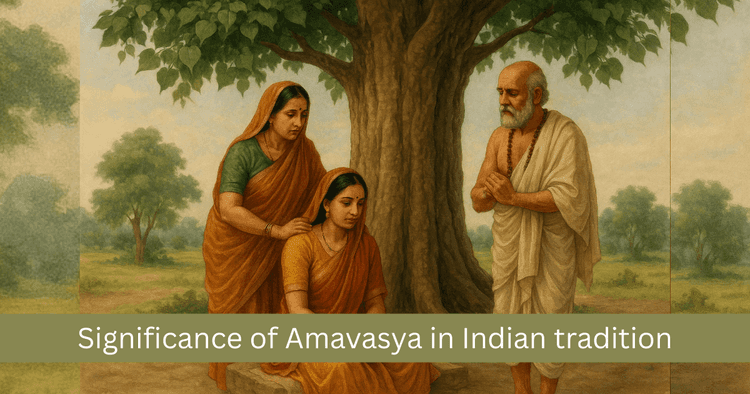
Table of Contents
Somvati Amavasya is regarded as an auspicious time in the traditional calendar and when the new moon coincides with a Monday the spiritual influence becomes stronger. Scriptures describe this day as a doorway for purification and remembrance. The practices performed on this day are believed to create harmony within the family lineage and offer a renewed sense of peace.
What makes the date of Somvati Amavasya spiritually powerful
The new moon is a time when the mind becomes sensitive because the Sun and the Moon stay in the same sign. When this day falls on a Monday the effect strengthens because Monday is associated with Lord Shiva. It is a suitable time for ancestral offerings and for inner reflection.
The delay in marriage and the sorrow of a devoted daughter
Once a humble Brahmin lived with his wife and only daughter. The daughter was gentle and dedicated to her duties. She performed worship every day and served elders with sincerity. Yet her marriage did not take place and proposals failed repeatedly. The parents became worried and tried many remedies but no solution emerged.
Tithi: The Subtle Dimension of Time in Vedic Astrology
A sage reveals the reason behind the obstacle
One day an aged ascetic arrived at their door. The couple welcomed him and told him their concern. After deep meditation he revealed that the daughter faced an obstacle due to ancestral imbalance. Until this was resolved her marriage would not be possible. The Brahmin asked for a remedy and the sage disclosed the sacred procedure related to Somvati Amavasya.
What is the special practice of Somvati Amavasya
The sage instructed that when the new moon falls on a Monday the girl must perform one hundred and eight circumambulations of a Peepal tree along with a devoted married woman. During the circumambulations she should remember Lord Vishnu and her ancestors. After this ritual she must offer water to the ancestors feed Brahmins and give food to the poor. These actions bring balance to the lineage.
The search for a devoted woman and preparation for worship
When Somvati Amavasya arrived the Brahmin searched for a woman who was loyal to her husband and pure in conduct. He found such a woman and told her the purpose. She agreed to join them. With faith in their hearts the family prepared for the ritual and approached the Peepal tree.
The ritual of circumambulation and the process of offering
They first offered water flowers and light to the sacred tree. Then the daughter along with the married woman performed one hundred and eight circumambulations while remembering the ancestors. Afterward they offered water for the departed souls fed Brahmins and gave food to the needy. Charity was considered an important part of the ritual.
The auspicious result and the daughter’s blessed future
Within a short time a suitable and noble groom was found for the girl. Her marriage took place joyfully and her life became peaceful and prosperous. The family believed that the sacred observance of Somvati Amavasya blessed their home.
The deeper message of this ancient story
The story conveys that faith and disciplined action can change difficult circumstances. The practices of Somvati Amavasya bring peace to the ancestral line and create harmony within the family. Women observe the day for the well being of their husbands and for the prosperity of their home. The ritual inspires purity of thought speech and action.
FAQs
Why is the Peepal tree worshipped on Somvati Amavasya
The Peepal tree is considered sacred and the circumambulation is believed to calm ancestral imbalance and bring mental peace.
Why must the ritual be done with a devoted married woman
Her purity and commitment strengthen the effect of the ritual and remove obstacles.
Which rituals are most significant on this day
Peepal circumambulation ancestral offering and worship of Lord Shiva hold great importance.
Is the observance limited to women only
Men can also perform ancestral offerings and charity which benefits the entire family.
Are there other ways to reduce ancestral imbalance
Offering water to ancestors charity and worship on new moon days are helpful.
Get your accurate Kundali
Generate KundaliDid you like it?
Author

Pt. Suvrat Sharma (63)
Experience: 20
Consults About: Family Planning, Career
Clients In: Punjab, Haryana, Delhi
Explore Related Articles
Explore All
Nirjala Ekadashi 2025: The Most Rigorous and Auspicious Fasting Day of the Year

Nirjala Ekadashi Story: When Bhimasena Conquered Hunger and Attained Liberation
Vat Savitri Vrat 2025: Date, Rituals, Story and Significance

The Remarkable Story of Vat Savitri Vrat: When a Woman Reclaimed Life from Death
Vat Savitri Vrat Aarti: Auspicious Worship of Goddess Gauri for Unbroken Fortune

निर्जला एकादशी 2025: वर्ष की सबसे कठिन परंतु सर्वाधिक पुण्यदायी तिथि
Share this article with friends and family
About ZODIAQ
ZODIAQ is an online Vedic Astrology platform. It connects clients seeking astrological advice to experienced astrologers with deep knowledge. Our users also generate kundali and perform kundali milan for free. ZODIAQ also offers services to the Astrologers. Astrologers utilize various offerings by ZODIAQ to serve their clients effectively.
If you are a User
Consult with experienced astrologers and seek their guidance. You can also order handwritten Janm Patrika report with life prediction prepared by experienced astrologers. Generate accurate Kundali, perform Kundali Matching and check horoscope and muhurat. Utilize our online library for all the necessary astrological and spiritual information.
If you are an Astrologer
Create accurate kundali for your clients and perform Kundali Matching for up to 5 people at a time. Write comprehensive Janm Patrika report for your clients with ZODIAQ. Check client details anytime by saving it in client directory. Become more productive by tracking how many clients you guide every day.
WELCOME TO
ZODIAQ
Right Decisions at the right time with ZODIAQ
