Gajendra Moksha Stotra: When an Elephant Showed the Path to Liberation
By Aparna Patni
Explore the divine essence of Gajendra Moksha Stotra-its story, spiritual meaning and how recitation leads to grace and peace
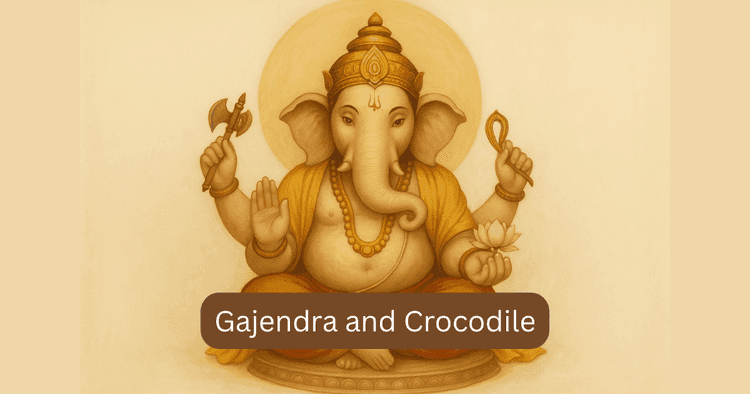
Table of Contents
Gajendra Moksha Stotra is not just a scriptural chant, it is a living expression of complete surrender to God, unshakeable faith and the deepest cry of the soul. Originating from the eighth canto of Shrimad Bhagavatam, where Sage Shukadeva narrates the story of Gajendra Moksha to King Parikshit, this stotra reflects the inner battle between hope and fear, effort and surrender that every human being faces.
Gajendra’s Prayer: The Core Stotra And Meaning
In the Bhagavatam, Gajendra, the king of elephants, caught in the jaws of a crocodile, remembers a divine hymn learned in his previous birth and begins to offer intense praise to the Supreme Lord.
Sage Shukadeva says that Gajendra firmly fixed his mind in the heart and started chanting the supreme mantra of praise, learned in a former life. He said:
“Om namo Bhagavate” salutations to that Supreme Lord who is pure consciousness, the primal cause of the universe, the original seed of all beings and the supreme controller. In him this universe rests, from him it originates, by him it is sustained, he himself is everything yet he also transcends all, to that self-born Supreme I surrender.
He is the one who, in his own being, projects this universe through his Maya, sometimes revealing it and sometimes withdrawing it. Both the ignorant soul, deluded by avidya, and the witnessing self behold his play, may that supreme, root of all, protect me.
When by the influence of time even the creators and protectors of the worlds reach dissolution and darkness alone remains, it is beyond that deep, impenetrable gloom that the Supreme Lord shines eternally, may that all-pervading being be my refuge.
Even gods and sages cannot comprehend his path, then how can ordinary creatures fully describe him, just as it is difficult to trace all the movements of an actor who constantly changes forms. May that Lord who is beyond all paths protect us.
Gajendra then praises the Lord as the highest goal of sages who abandon attachment, as the one without birth, name or form who yet appears for the sake of the world, as the formless yet wondrous source of all powers, as the inner light of consciousness beyond words and mind, the master of liberation and giver of nirvana-bliss, the witness, knower of the field and root of primal nature.
He prays to the Lord who appears only to free bound souls like himself from the noose of bondage, who is ever free, infinitely compassionate and the shelter of peace. He seeks not mere boons or worldly enjoyment but final release from birth and death.
At last he says that those who worship this Supreme for the sake of dharma, artha, kama or moksha surely attain their desired goals, but he himself desires only absolute freedom from bondage, not even an imperishable body. He praises the Lord as the ocean of bliss in which single-hearted devotees forget all worldly cravings and rejoice in singing his wondrous, auspicious deeds.
Panchang: The Foundation of Vedic Astrology and Its Role in Life
The Story Of Gajendra Moksha (Summary)
- In a previous birth, Gajendra was King Indradyumna, a devout Vishnu bhakta who unintentionally disrespected Sage Agastya and was cursed to be born as an elephant, so that his pride would fall and his devotion be tested.
- As Gajendra, he lived in the heavenly garden Ritumat with his herd, enjoying beauty and peace while inwardly worshipping Lord Vishnu by offering lotuses every day.
- One day, as he entered the lake for play and worship, a powerful crocodile caught his leg. A long, exhausting struggle followed, his strength faded and all his companions left helpless.
- When every worldly support failed and death seemed certain, Gajendra turned inward, remembered the Supreme and with his trunk lifted a lotus as an offering, crying out to Vishnu with total surrender.
- Hearing this pure call, the Lord immediately mounted Garuda, arrived with Sudarshana Chakra, slew the crocodile and freed Gajendra, granting him liberation and revealing his previous identity as Indradyumna.
The story reveals that in the final analysis only wholehearted surrender to God becomes the true rescue from worldly and karmic bondage.
Greatness Of Gajendra’s Stuti
Gajendra’s hymn is the voice of a soul that has realized the limits of its own strength and effort. It arises when ego and self-reliance collapse and only faith remains. That is why this stotra is considered one of the most powerful praises of the Supreme Lord, expressing pure surrender, deep Vedantic insight and intense bhakti in one stream.
Benefits Of Reciting Gajendra Moksha Stotra
- Protection In Extreme Difficulties: In times when no solution seems visible and all human efforts fail, this stotra fills the heart with courage, faith and divine support.
- Progress Toward Liberation: Just as Gajendra attained moksha, the stotra turns the mind toward detachment, surrender and inner freedom from fear and bondage.
- Relief From Past Karmas: Tradition holds that regular recitation softens and burns away the binding force of many past wrong actions.
- Help In Financial And Life Challenges: Especially when chanted in Kartik month at dawn, it is believed to aid in debt-relief and material stability.
- Pacification Of Pitru Dosha: Reading it during Shraddha fortnight, on Amavasya or days of ancestral worship is considered auspicious for relief from Pitru-related karmic obstacles.
- Freedom From Fear Of Death: One who recites with devotion is said to gain inner fearlessness and move toward higher realms rather than dark states after death.
Method Of Recitation
- Time: Early morning or evening is ideal, when the mind is naturally quieter and more receptive.
- Place: Sit in a clean, peaceful space in front of Lord Vishnu’s image, Shaligrama or a sacred symbol like Shankha and Chakra.
- Preparation: Bathe, wear clean clothes, light a lamp, offer tulsi, flowers and, if possible, a lotus in remembrance of Gajendra’s offering.
- Inner Attitude: Before starting, spend a few moments feeling your own helplessness before life’s vastness and consciously place your trust in God’s protection.
- Recitation: Chant the stotra slowly, with attentive pronunciation and heartfelt understanding of the meaning, letting each line sink into the heart.
- Regularity: Daily practice is ideal, yet even on Ekadashi, Thursdays, Amavasya or during personal crises, consistent recitation creates powerful inner support.
Spiritual Lessons From Gajendra Moksha
- Human strength, intelligence and support from others are limited; divine grace begins where ego-driven effort fails.
- God responds not to outer form or status but to the intensity of sincere surrender and faith.
- Past karmas and present sufferings can become ladders toward liberation when they drive us to complete reliance on the Supreme.
- Devotion to Lord Vishnu, expressed through trust and heartfelt calling, can burn away fear, pride and false dependence.
Conclusion
Gajendra Moksha Stotra is not just a story of an elephant and a crocodile, it is the lived journey of every seeker who struggles with fear, attachment and helplessness yet finally learns to call upon God with a pure heart. When all outer supports fall away, the power to remember and call the Lord remains, and that call itself becomes the doorway to true moksha.
In truth, Gajendra Moksha reminds us that surrender and bhakti are not weakness but the highest spiritual strength, for through them one crosses from suffering to peace, from death’s fear to divine protection.
FAQ
1.In which scripture and context does Gajendra Moksha Stotra appear?
It appears in the eighth canto of Shrimad Bhagavatam, where Sage Shukadeva narrates the story of Gajendra’s deliverance from the crocodile and his liberation by Lord Vishnu.
2.Who was Gajendra in his previous birth and why was he reborn as an elephant?
In his previous birth, Gajendra was King Indradyumna, a devoted Vishnu bhakta who was cursed by Sage Agastya to be born as an elephant because he failed to show proper respect, so that his pride would be corrected and his devotion perfected.
3.What is the central spiritual teaching of Gajendra Moksha Stotra?
The main teaching is that when all personal efforts and supports fail, complete surrender to the Supreme Lord alone can bring true rescue and liberation from fear, bondage and death.
4.Is this stotra meant only for times of crisis?
While it is especially powerful in crisis, regular recitation transforms it into a deep sadhana that develops fearlessness, devotion, peace and readiness to face life and death with trust in God.
5.How does Gajendra Moksha Stotra relate to Pitru Dosha and difficult karmas?
Traditionally, reciting it during Shraddha, Amavasya or ancestral rites is believed to help pacify Pitru-related karmic blocks and soften the effects of heavy past actions, because it is an intense expression of surrender to Vishnu.
6.Is understanding the meaning necessary or is mere recitation enough?
Understanding the meaning greatly enriches the practice, as the heart and intellect both turn to God. However, sincere and respectful recitation also carries spiritual benefit, especially when combined with growing contemplation of its message.
7.Can a busy householder realistically include this stotra in daily life?
Yes, even a shortened daily practice or a few selected verses recited with faith can bring calm, clarity and connection with Lord Vishnu, while a fuller recitation on special days deepens the impact.
Get your accurate Kundali
Generate KundaliDid you like it?
Author

Aparna Patni (63)
Experience: 20
Consults About: Family Planning, Career
Clients In: Punjab, Haryana, Delhi
Explore Related Articles
Explore All
Vishnu Sahasranama Stotra: The Infallible Medium of Divine Worship
The Maha Mrityunjaya Mantra: Ancient Prayer That Transforms Fear Into Liberation
Shri Gajanan Stotra: A Spiritual Source of Wisdom, Prosperity and Peace
Shiva Tandava Stotram: The Hymn by Ravana That Invokes Shiva’s Divine Grace
महामृत्युंजय मंत्र: प्राचीन प्रार्थना जो भय को मुक्ति में बदलती है
श्री गजानन स्तोत्र: बुद्धि, समृद्धि और शांति का आध्यात्मिक स्तोत्र
Share this article with friends and family
About ZODIAQ
ZODIAQ is an online Vedic Astrology platform. It connects clients seeking astrological advice to experienced astrologers with deep knowledge. Our users also generate kundali and perform kundali milan for free. ZODIAQ also offers services to the Astrologers. Astrologers utilize various offerings by ZODIAQ to serve their clients effectively.
If you are a User
Consult with experienced astrologers and seek their guidance. You can also order handwritten Janm Patrika report with life prediction prepared by experienced astrologers. Generate accurate Kundali, perform Kundali Matching and check horoscope and muhurat. Utilize our online library for all the necessary astrological and spiritual information.
If you are an Astrologer
Create accurate kundali for your clients and perform Kundali Matching for up to 5 people at a time. Write comprehensive Janm Patrika report for your clients with ZODIAQ. Check client details anytime by saving it in client directory. Become more productive by tracking how many clients you guide every day.
WELCOME TO
ZODIAQ
Right Decisions at the right time with ZODIAQ
